
Abstract
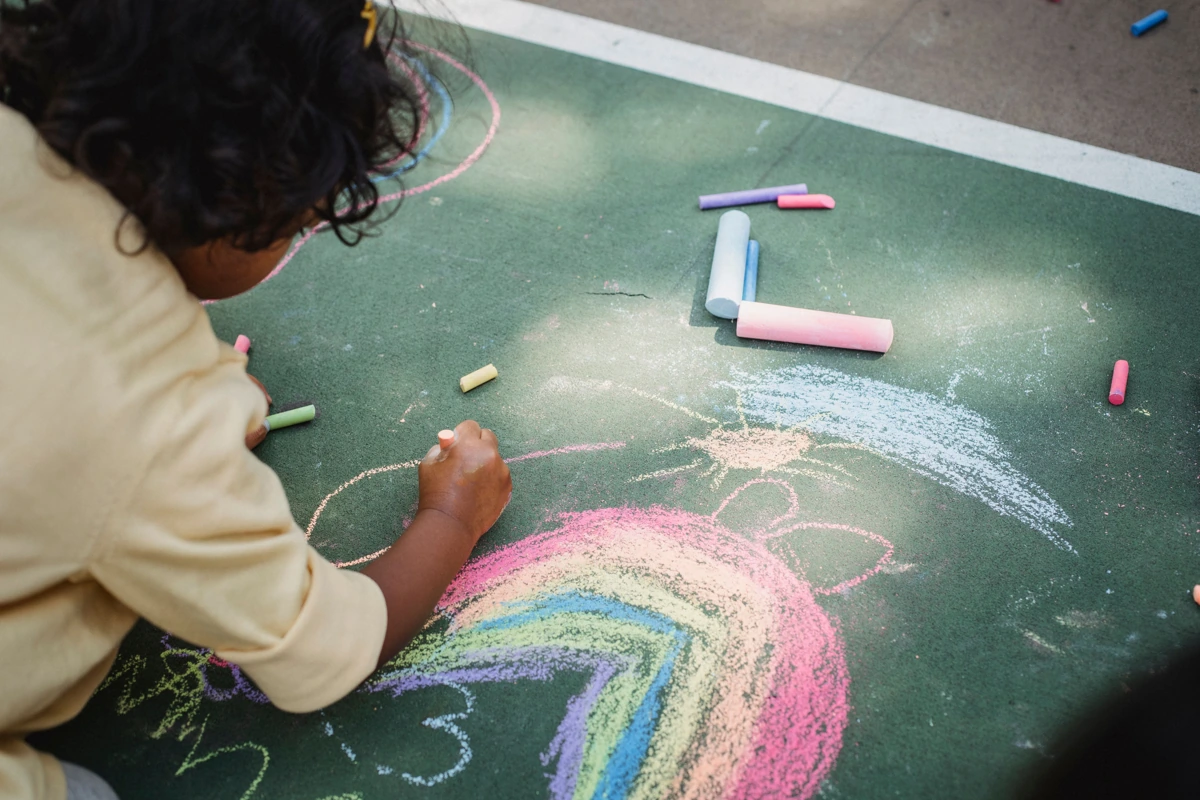
The rainbow is unusual among the things children draw: it is a real optical phenomenon that shares its cultural habitat with unicorns, pots of gold, and bridges to the gods. It therefore offers a natural probe of a question that is otherwise hard to put to children whether an object’s standing as real or imagined is a property the child holds, or a property the occasion confers. We examined every rainbow in three coded Blue Blocks datasets: 81 drawings made to the prompt “draw a place where life can exist” (Rao & Chakraborty, 2026b) and 198 paintings made under an open thematic condition (Donakanti, 2026b), with the two linked through a combined comparative deposit (Chakraborty, 2026). Three results follow. First, in the prompted condition the rainbow behaves as a natural element and specifically as a light element: it appears in 6 of 81 drawings (7.4%), always with the sun (6 of 6, against 54.7% elsewhere) and almost never with rain (1 of 6, against 14.7% elsewhere). Children draw the rainbow’s apparent cause and omit its actual one. Second, the rainbow is rare but marks abundance: rainbow drawings average 10.17 biophilic elements against 4.97 for the rest, and four of the six sit in the richest sixth of the sample, including the single richest drawing. Third, and centrally, the rainbow changes company with the frame. In the prompted condition it is house-poor, tree-rich, and never once appears in a drawing the observer classified as mixed or built. In the unprompted condition, four of the six rainbow paintings were independently classified as supra-nature against a base rate of 20.7%, sharing the page with flying saucers, planets, anthropomorphic animals, and invented cities. Eleven distinct children produced a rainbow across 279 artworks, and not one produced a rainbow in both conditions. We argue that the rainbow functions as a boundary object whose ontological side is assigned by the task, not carried by the child, and that its causal decoupling from rain marks it as an emblem of light rather than a depiction of optics. Detection was asymmetric across conditions, and all counts are small; the argument is offered as a hypothesis.
Keywords: children’s drawings, rainbow, boundary object, fantasy–reality distinction, supra-nature, prompt effects, artificialism, causal reasoning, biophilia, developmental psychology
Why the rainbow
Most of what a child draws is unambiguous. A tree is real; a unicorn is not. The rainbow belongs to neither list. It is a genuine optical event, explicable since Newton (1704) as the
refraction and internal reflection of sunlight in suspended water droplets, and it is also one of the most heavily mythologised objects in the visual repertoire a bridge to the gods, a divine covenant, a messenger’s road, and, in the register children meet earliest, the thing with a pot of gold at the end of it (Boyer, 1959; Lee & Fraser, 2001). No other item on a standard drawing checklist has this double residence.
That doubleness makes the rainbow a useful probe. Children’s grasp of the fantasy–reality boundary has been studied largely by asking them to judge whether a monster is real or could this happen (Woolley, 1997; Sharon & Woolley, 2004; Harris, 2000). Drawing lets us ask a different and quieter question. We cannot see, from a drawing, what a child believes about rainbows. But we can see what a rainbow is next to. If an object’s ontological standing is a stable property the child carries, the rainbow should keep roughly the same company wherever it turns up. If it is assigned by the occasion, the rainbow should migrate sitting among trees and birds when the task points at the real world, and among planets and talking animals when the task points nowhere in particular.
The Blue Blocks corpus makes exactly that comparison possible, because the same school’s children were sampled under two conditions with two independent coding instruments: a prompted ecological drawing task, and an open thematic painting day. This paper follows the rainbow across both. It is a narrow study of a single element and it makes no claim beyond that element.
Data and detection
This is a secondary, descriptive analysis. No new data were collected. Three public deposits are used. The prompted condition is the Blue Blocks Biophilia Pilot Study: 81 children aged 6–16 at Blue Blocks Montessori School, Hyderabad (47 male, 34 female; 6–8 n = 51, 9–12 n
= 17, 13–16 n = 8), each drawing coded by a trained observer for the presence or absence of thirty elements, one of which is Rainbow (Rao & Chakraborty, 2026a, 2026b; preregistration: Blue Blocks Micro Research Institute, Chakraborty, & Rao, 2026). The unprompted condition is Drone & Art Day: 198 paintings made under an open theme, coded on a different instrument built around a nature / supra-nature classification and a set of imaginative-content variables, with free-text observer notes (Donakanti, 2026a, 2026b). The two are linked by a combined comparative deposit that identifies 53 students appearing in both (Chakraborty, 2026). Observation, ethics, and data handling followed the institute’s standing protocols (Blue Blocks Micro Research Institute, Goyal, Chakraborty, & Ediga, 2026; Blue Blocks Micro Research Institute, 2026a, 2026b, 2026c).
One feature of this design must be stated before any number is read, because it constrains everything that follows. Detection of the rainbow is asymmetric. The prompted instrument has a dedicated Rainbow checkbox; the unprompted instrument does not, and rainbows there could only be found by searching the observers’ free-text notes. Notes record what an observer thought worth writing down, not everything present, so the unprompted count is a floor and almost certainly an undercount. It follows that the two prevalence rates are not comparable and
we do not compare them. What is comparable is the internal structure of each condition: what the rainbow sits beside, within the coding available for that condition. Every cross-condition claim below is of that form.
All analyses are descriptive. No significance tests are reported; with six rainbow cases per condition none would be meaningful. In the 22-drawing double-coded reliability subset of the prompted study, the Rainbow code showed complete agreement between observers (22 of 22), including the one positive case it contained, reassuring about coding consistency, but resting on a single positive and not to be read as established reliability for this element.
Results
Rare, and attached to the richest drawings
The rainbow appears in 6 of 81 prompted drawings (7.4%), ranking twenty-seventh of the thirty coded elements rarer than insects, rarer than fish, ahead only of “other living creature,” the waterfall, and the moon and stars. Yet the drawings it appears in are not marginal ones. Their mean Total Biophilic Element Count is 10.17, against 4.97 for the remaining 75 drawings and
5.36 for the sample as a whole. Four of the six sit in the richest sixth of the dataset, and the single richest drawing in the entire study the only one scoring the maximum 23 of 23 biophilic elements contains a rainbow (Table 1). The rainbow is not a common decoration. It is an uncommon element that turns up when a child is building the fullest world they can.
|
|
|
|
|
|
|---|---|---|---|---|---|
|
|
|
|
|
|
|
|
|
|
|
|
|
|
|
|
|
|
|
|
|
|
|
|
|
|
|
|
|
|
|
|
|
|
|
|
Table 1. The six rainbow drawings in the prompted condition, ordered by biophilic richness. Rank is out of
81. Case labels are analysis identifiers, not participant codes.
All six were classified by the observer as biophilic in orientation three strongly, three predominantly. Not one appeared in a drawing classified as mixed, predominantly built, or strongly built/urban. In the prompted condition the rainbow belongs, without exception, to the natural pole of the sample.
The rainbow has no rain
What the rainbow sits beside is more informative than how often it occurs (Table 2). The sun is present in all six rainbow drawings 100%, against 54.7% of the rest. Clouds are present in five of six, against 29.3%. Birds, likewise, in five of six against 24.0%. But rain, which is the physical precondition of a rainbow, appears in only one of the six, a rate indistinguishable from the 14.7% found elsewhere in the sample. The relationship does not hold in the other direction either: eight drawings in the whole dataset contain both sun and rain, and only one of them contains a rainbow.
|
|
|
|---|---|---|
|
|
|
|
|
|
|
|
|
|
|
|
|
|
|
|
|
|
|
|
|
|
|
|
|
|
|
Table 2. Co-occurrence profile of the rainbow in the prompted condition. Percentages are within each column’s denominator.
The rainbow is also, distinctively, a house-poor element. Buildings or houses appear in 72.0% of non-rainbow drawings but only two of the six rainbow drawings, and human figures are no more likely to be present than elsewhere. Water elements of any kind are, if anything, slightly less frequent than in the rest of the sample. The rainbow does not travel with dwelling, with people, or with water. It travels with the sun, the clouds, the birds, and the trees with the sky and the living landscape.
The company changes when the frame does
In the unprompted condition, six of the 198 paintings mention a rainbow in the observer’s notes. Four of those six were independently classified as supra-nature on an instrument that knows nothing of the biophilia coding scheme, against a base rate of 20.7% (41 of 198) for that classification across the whole set (Table 3). What the rainbow shares the page with in this condition is a different order of thing: a Saturn-like planet and a flying saucer; anthropomorphic bunny and cat characters among stars and hearts; an invented city with a welcome sign on the building; a space-fantasy scene of planets and wild nature. Two remain on the nature side, stick figures dancing around a rainbow arc, and a winter scene containing snow, a snowman, rain, a
person, and a house. The winter painting is, incidentally, the one unprompted case in which the rainbow keeps company with its own meteorological cause.
|
|
|
|
|
|---|---|---|---|---|
|
|
|
|
|
|
|
|
|
|
|
|
|
|
|
|
|
|
|
|
|
|
|
|
|
|
|
|
|
|
Table 3. The six rainbow paintings in the unprompted condition, with the observer’s description of surrounding content. Classification is from the nature / supra-nature instrument, coded independently of the biophilia scheme.
The contrast is the finding. Under a prompt that names life and a place, the rainbow is a sky element in a landscape and never once strays into a built or mixed scene. Under an open theme, two-thirds of its appearances fall on the imaginative side of a boundary drawn by a different observer using different criteria. Nothing about the object changed. The question changed.
Not a personal trait
One obvious alternative is that rainbows are simply what certain children draw that we are seeing eleven rainbow-inclined individuals rather than a property of the task. The paired structure of the corpus tests this directly. Across 279 artworks, eleven distinct children produced a rainbow. Not one of them produced a rainbow in both conditions. Six of the eleven are among the 53 students who contributed to both studies, and every one of those six drew a rainbow in exactly one condition and not the other. On the evidence available, rainbow production is occasion-bound rather than person-bound. The counts are small and this is not a strong test, but it points away from the individual-disposition account rather than toward it.
A gender asymmetry that repeats
In the prompted condition, five of six rainbow drawings were made by girls, against a sample that is 34 female to 47 male. In the unprompted condition, five of six rainbow paintings were made by girls, against a sample that is 81 female to 114 male. Two samples, two coding instruments, two detection methods, and the same five-to-one split against a male-majority base in both. We report this because it replicated and because concealing it would be worse than
over-reading it, but six cases twice over cannot establish an effect, and the mechanism exposure, motif availability, colour preference, something else entirely is not addressed by these data. It is a candidate for a properly powered test, not a result.
Discussion
A boundary object placed by the frame
Star and Griesemer (1989) described boundary objects as things robust enough to keep their identity across different communities of practice while taking on different meanings within each. The rainbow, in this corpus, behaves like a boundary object across two task frames rather than two communities. It is stable as an image an arc of colour, recognisably the same drawn form and unstable in its affiliation. Asked for a place where life can exist, children file it with the sun and the birds. Left to choose, they file it with the flying saucer and the talking rabbit.
This has a consequence for how the real/imaginary distinction in children’s art is usually studied. The nature / supra-nature classification treats each artwork as evidence about a child’s conception of the real and the imaginary (Donakanti, 2026a). The rainbow data suggest that for at least some content the classification may be measuring the task as much as the child. An object that lands on the nature side under one prompt and the supra-nature side under another has not told us where the child places it. It has told us that the child places it wherever the question points which is itself the more interesting fact, and consistent with what the institute’s prompt-comparison work has found at the level of whole drawings (Rao, Chakraborty, & Donakanti, 2026; Chakraborty, 2026).
An emblem of light, not a depiction of optics
The second result is independent of the first and, we think, the more surprising. Even in the condition where the rainbow behaves as a natural element, it is not drawn as a natural process. A rainbow requires falling water and light behind the observer. Children supplied the light in every single case and the water in one. The dependency runs one way only drawing the actual preconditions did not produce rainbows either, since only one of the eight sun-and-rain drawings contains one.
What children appear to be drawing, then, is not the outcome of a meteorological event but a member of the sky-and-light family: an emblem grouped with the sun and the clouds by kind rather than by cause. This is a recognisable form of the causal reasoning Piaget (1929) documented in children’s explanations of natural phenomena, where an object’s account is assembled from what it resembles and what it belongs with rather than from what produces it. It is also consistent with the older history of the object itself, in which the rainbow was for centuries a sign before it was an optical effect (Lee & Fraser, 2001). The children in this sample have arrived at the pre-Newtonian rainbow without instruction: a bright arc that belongs to the sun, is not caused by anything, and means that the world is going well.
That last clause is an interpretation, but the abundance result supports it. The rainbow does not appear in thin drawings. It appears in full ones the fullest in the dataset alongside flowers, fruit, birds, and trees. Whatever the rainbow is doing in these drawings, it is doing it at the top of the scale, in scenes where the child has already put in everything else they could think of. It reads less like an item on a list than like a finishing mark.
What would decide this
Four cheap tests follow, and each can go against us. (i) Add a Rainbow code to the unprompted instrument. Everything in Section 3.3 rests on notes-based detection; a dedicated code would establish whether the prevalence difference is real and whether the supra-nature association survives full ascertainment. (ii) Ask the children who drew one how a rainbow happens, and whether it could be touched or reached. If the emblem reading is right, explanations should invoke the sun and colour far more than falling water, and the reaching question should divide children more sharply than the same question about a cloud. (iii) Prompt explicitly for the cause “draw a rainbow and what makes it” and see whether rain is supplied on request. If it is, the omission is one of salience rather than of causal understanding. (iv) Sample the fairy-tale register directly by asking whether anything is at the end of the rainbow. The pot of gold does not appear anywhere in either dataset; whether that is because it is absent from these children’s repertoire or because no task invited it is currently unknown, and it is the cleanest available test of whether the mythic rainbow is present but dormant.
Limitations
The counts are very small: six rainbow drawings and six rainbow paintings. Nothing here is a statistical result and none of it should be cited as one. Detection is asymmetric a dedicated code in one condition, free-text notes in the other so the prevalence figures are not comparable and the unprompted count is a floor. The two conditions differ in more than framing: medium (drawing versus painting and collage), occasion, group composition, age range, and coding instrument all vary together, so “the frame” is a shorthand for a bundle of differences that this design cannot separate. The nature / supra-nature classification is an observer judgement and the rainbow may itself have influenced it, which would make the association in Section 3.3 partly circular; the four supra-nature paintings do, however, contain independently coded fantasy content that would carry the classification without the rainbow. Both samples come from one school in one city and one pedagogical tradition, and no claim to cultural generality is made, the mythic freight the rainbow carries is culturally specific, and a Hyderabad sample cannot speak for the pot of gold. Finally, absence on the page is not absence in the mind: a child who did not draw a rainbow may still hold every belief about rainbows we have speculated about here.
Conclusion
The rainbow is the one thing on the coding sheet that is simultaneously true and enchanted, and the children in this corpus treated it accordingly. Asked where life can exist, they put it in the sky beside the sun and the birds, in the richest and greenest scenes they made, and never in a city. Left to paint what they liked, they put it beside flying saucers and talking animals. No child did both. And in neither condition did they draw the rain that makes it.
We take from this that the rainbow’s standing as real or imagined is not something these children carry and reveal, but something the occasion assigns and that the rainbow they draw is not the one Newton explained but the older one, a bright arc belonging to the sun, uncaused, and reserved for the fullest version of the world. Both claims rest on twelve artworks and are offered as hypotheses. A rainbow code in every instrument, and one question put to the child who drew it, would be enough to test them.
Data Availability
All datasets analysed here are publicly deposited: the prompted condition at https://doi.org/10.7910/DVN/AWUK3Z (Rao & Chakraborty, 2026b), the unprompted condition at https://doi.org/10.5281/zenodo.20406121 (Donakanti, 2026b), and the linked comparative deposit at https://doi.org/10.7910/DVN/8DMD5R (Chakraborty, 2026). The prompted study’s pre-registration is at https://doi.org/10.17605/osf.io/f296r. No new data were collected. Case labels in Tables 1 and 3 are analysis identifiers assigned for this paper and do not correspond to participant codes, in line with the Child Data Classification Standard (Blue Blocks Micro Research Institute, 2026b).
Acknowledgements
The authors thank the children of Blue Blocks Montessori School, Hyderabad, and the observer-guides who coded both the drawing and the painting sessions. This analysis was conducted within the embedded-research framework of the Blue Blocks Micro Research Institute and in compliance with its standing protocols (BEOP, MREF, CDCS). Author contributions and order are provisional and to be confirmed by the authors prior to submission.
References
Blue Blocks Micro Research Institute. (2026a). Blue Blocks Embedded Observation Protocol (BEOP v1.0): A standard for practitioner-led observation in educational settings. Blue Blocks Micro Research Institute. https://doi.org/10.5281/zenodo.19087415
Blue Blocks Micro Research Institute. (2026b). Child Data Classification Standard (CDCS v1.0): A data governance standard for child development research. Blue Blocks Micro Research Institute. https://doi.org/10.5281/zenodo.19202499
Blue Blocks Micro Research Institute. (2026c). Micro Research Ethics Framework (MREF v1.0): An ethics standard for embedded educational research. Zenodo. https://doi.org/10.5281/zenodo.19047669
Blue Blocks Micro Research Institute, Chakraborty, S., & Rao, S. (2026). Drawing life: Spontaneous biophilic imagery in children’s responses to an open-ended prompt — A pilot study [Preregistration]. OSF. https://doi.org/10.17605/osf.io/f296r
Blue Blocks Micro Research Institute, Goyal, P., Chakraborty, S., & Ediga, S. (2026). Blue Blocks micro research methodology: A practitioner-led, longitudinal framework for embedded educational research. Blue Blocks Micro Research Institute. https://doi.org/10.5281/zenodo.18584816
Boyer, C. B. (1959). The rainbow: From myth to mathematics. Thomas Yoseloff.
Chakraborty, S. (2026). Prompted ecological drawing versus thematic free expression in Montessori children aged 5–15: A comparative study across prompted and unprompted conditions — Dataset (Version 2.0) [Dataset]. Harvard Dataverse. https://doi.org/10.7910/DVN/8DMD5R
Chakraborty, S., Rao, S., & Goyal, P. (2026). Biophilia in the classroom: How traditional and Montessori schools engage children’s innate connection to nature (Version 1.0). Zenodo. https://doi.org/10.5281/zenodo.21126658
Cox, M. (1992). Children’s drawings. Penguin.
Donakanti, V. S. (2026a). Nature vs. supra-nature: How Montessori children conceptualise the real and imaginary through visual art (Version 1.0). Blue Blocks Micro Research Institute. https://doi.org/10.5281/zenodo.20406479
Donakanti, V. S. (2026b). Nature vs. supra-nature: How Montessori children conceptualize the real and imaginary through visual art — Dataset (Version 1.0) [Dataset]. Blue Blocks Micro Research Institute. https://doi.org/10.5281/zenodo.20406121
Golomb, C. (1992). The child’s creation of a pictorial world. University of California Press.
Harris, P. L. (2000). The work of the imagination. Blackwell.
Kellogg, R. (1969). Analyzing children’s art. National Press.
Lee, R. L., Jr., & Fraser, A. B. (2001). The rainbow bridge: Rainbows in art, myth, and science. Pennsylvania State University Press.
Newton, I. (1704). Opticks: Or, a treatise of the reflexions, refractions, inflexions and colours of light. Sam. Smith and Benj. Walford.
Piaget, J. (1929). The child’s conception of the world. Kegan Paul.
Rao, S., & Chakraborty, S. (2026a). Drawing life: Spontaneous biophilic imagery in children’s responses to an open-ended prompt — A pilot study from Blue Blocks Montessori School, Hyderabad, India. SSRN. https://doi.org/10.2139/ssrn.6638898
Rao, S., & Chakraborty, S. (2026b). Drawing life: Spontaneous biophilic imagery in children’s responses to an open-ended prompt — A pilot study — Dataset [Dataset]. Harvard Dataverse. https://doi.org/10.7910/DVN/AWUK3Z
Rao, S., Chakraborty, S., & Donakanti, V. S. (2026). Phylogenetic echoes in children’s art: Biophilia, supra-nature, and the role of prompt in ecological drawing (Version 1.0). Research Square. https://doi.org/10.21203/rs.3.rs-9833827/v1
Sharon, T., & Woolley, J. D. (2004). Do monsters dream? Young children’s understanding of the fantasy/reality distinction. British Journal of Developmental Psychology, 22(2), 293–310.
Star, S. L., & Griesemer, J. R. (1989). Institutional ecology, “translations” and boundary objects: Amateurs and professionals in Berkeley’s Museum of Vertebrate Zoology, 1907–1939. Social Studies of Science, 19(3), 387–420.
Wilson, E. O. (1984). Biophilia. Harvard University Press.
Woolley, J. D. (1997). Thinking about fantasy: Are children fundamentally different thinkers and believers from adults? Child Development, 68(6), 991–1011.
© 2026 Blue Blocks Micro Research Institute. This working paper may be shared freely with attribution.