
Abstract
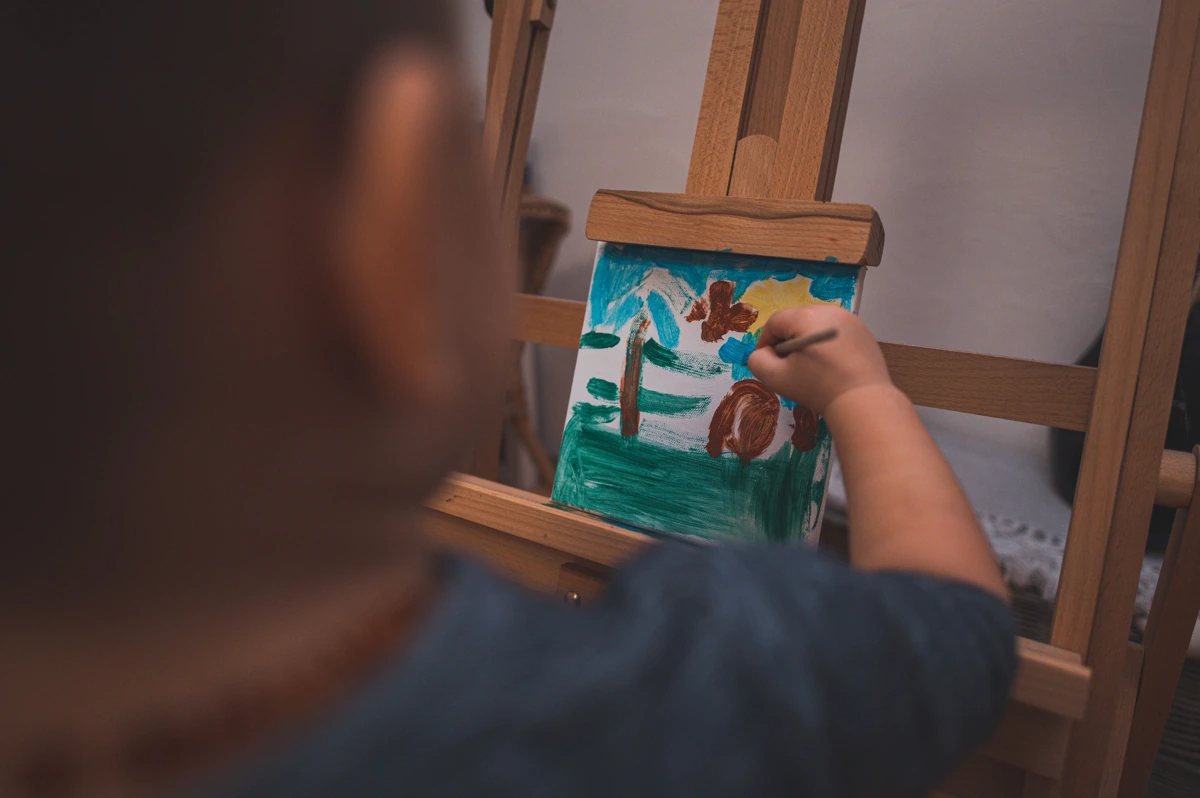
Eighty-one children aged 6–16 at a Montessori school were asked to draw a place where life can exist (Rao & Chakraborty, 2026a). Re-examining the coded dataset (Rao & Chakraborty, 2026b), we report a single figure that reframes what the drawings show. The dataset contains 56 houses and 31 human figures. Because these are marginal totals over the same 81 drawings, at least 25 drawings, a floor of 44.6% of every house drawn contain, a dwelling with nobody in it, and 42.0% of the sample contains no living creature of any kind, human or animal. The children built an inhabited world and left almost nobody in it. This paper treats that gap as a psychological object rather than as a deficit, and makes two claims. First, the children answered the prompt indexically rather than iconically: they drew the signs by which the presence of life is inferred: shelter, planting, water, light, rather than instances of life itself, in the way an exobiologist searches for biosignatures rather than for organisms. Second, the figure is missing from the scene for the same reason the eye is missing from the visual field: the unrendered inhabitant is the child, and the drawing is a world composed from a position that cannot appear inside it. On this reading the empty house is not an emptiness but a vantage. Four falsifiable predictions follow, each answerable with one additional question put to the child. All figures are descriptive and drawn from a single small pilot; the interpretation is offered as a hypothesis, not a finding.
Keywords: children’s drawings, indexicality, absent figure, first-person perspective, prospect–refuge, phenomenology of perception, egocentric viewpoint, biophilia, developmental psychology
Introduction
A child handed a blank sheet and the words “draw a place where life can exist” is given an almost unlimited canvas. The prompt names no forest, no city, no ocean, no planet. What the child puts at the centre of the page is therefore informative: it is that child’s first answer to the question of where life belongs.
The pilot study from which this analysis is drawn found, as expected, that such drawings are overwhelmingly biophilic dense with trees, sun, and water (Rao & Chakraborty, 2026a). Beneath that headline the element-level data contain something the pilot did not pursue. The single most frequent element in the entire dataset is not a natural one. It is the house, present in 69.1% of drawings. And the least represented biophilic content is the one kind that is unambiguously alive: animate creatures, with non-human animals appearing in only 40.7% of drawings and 42.0% of the sample containing no living being at all.
Put those two facts side by side, and a third appears, which is the subject of this paper. There are 56 houses in this dataset and 31 people. The children drew nearly two dwellings for every dweller. They built the stage in detail, planted it, lit it, watered it, roofed it and then, most of the time, left nobody standing on it.
Our question is psychological and narrow. We do not ask here what these drawings imply about pedagogy, about school type, or about the effect of the prompt; those questions are addressed elsewhere in the institute’s programme on children’s ecological drawing (Chakraborty, Rao, & Goyal, 2026; Rao, Chakraborty, & Donakanti, 2026; Donakanti, 2026a). We ask what it means, for the child’s mind, that a picture of a place where life can exist should so often be a picture of an empty house. Our answer has two parts: that these children signified life indexically rather than depicting it, and that the one figure consistently missing from the scene is the one composing it.
Design, sample, and the status of these figures
This is a secondary, descriptive analysis of the coded dataset of the Blue Blocks Biophilia Pilot Study (Rao & Chakraborty, 2026a, 2026b), a single-session, group-administered, pre-registered pilot (Blue Blocks Micro Research Institute, Chakraborty, & Rao, 2026). No new data were collected. Participants, prompt, materials, administration, and coding are as reported in the parent study, to which the reader is referred for the full protocol.
The sample comprised 81 children (46 male, 35 female) at Blue Blocks Montessori School, Hyderabad, across three age bands: 6–8 (n = 51), 9–12 (n = 17), and 13–16 (n = 8), with five children unassignable to a band and retained only in whole-sample analyses. Consistent with the parent study, the oldest band falls below the pre-registered minimum and is treated as indicative only. Each drawing was coded by a trained observer for the presence or absence of thirty biophilic and built elements across five sections. We distinguish human figures from non-human animals (birds, fish and marine life, land animals, insects and butterflies, and other living creatures); a drawing contains a living creature if it contains a human figure or any non-human animal, and contains habitat if it contains any vegetation, sky/light, or water element. Data collection, observation, ethics, and data handling followed the institute’s standing protocols (Blue Blocks Micro Research Institute, Goyal, Chakraborty, & Ediga, 2026; Blue Blocks Micro Research Institute, 2026a, 2026b, 2026c). Inter-rater reliability in the parent study was high (95.7% agreement on orientation; element-count r = .989).
All analyses are descriptive, consistent with the pre-registered, no-inferential-test design of the parent pilot. No significance tests are reported and no difference is described as statistically reliable. One figure requires a note on its logic. We do not have a published cross-tabulation of house against human figure, and we do not construct one. What we use instead is a bound that follows deterministically from two marginal totals: with 56 houses and 31 human figures over 81 drawings, the number of drawings containing a house but no person cannot be lower than 56 − 31 = 25, even in the most generous case where every drawing containing a person also contains a house. The true number can only be higher. Every claim below rests on that floor, not on an assumed value.
What the drawings contain, and what they do not
Ranked by the number of drawings in which they appear, the elements at the top of the distribution are the house, the tree, and the sun; the animate elements cluster at the bottom (Table 1).
|
|
|
|---|---|---|
|
|
|
|
|
|
|
|
|
|
|
|
|
|
|
|
|
|
|
|
|
|
|
|
|
|
|
Table 1. Selected element frequencies across all 81 drawings. The most frequent element in the dataset is a built one; the animate elements occupy the lowest ranks.
The house and the tree do not compete. They co-occur in 44.4% of drawings, at least one of the two appears in 84.0%, and drawings containing a house are no poorer in natural content than those without one, a mean biophilic element count of 5.41 against 5.24. The modal drawing in this dataset is a shelter set inside a living landscape. What that landscape lacks is not vegetation, water, or light. It is anything alive (Table 2).
Of the 47 drawings that do contain a living being, the being is as likely to be a person as an animal: 14 contain a human but no animal, 16 an animal but no human, and 17 both. And the two animate presences move in opposite directions with age (Table 3). Non-human animals decline steadily across the bands while human figures, after dipping in the middle band, rise
sharply in the oldest — as though, as the animal world thins out of the picture, the human figure becomes the residual carrier of “life.” The oldest band rests on eight drawings and must be read as indicative.
|
|
|---|---|
|
|
|
|
|
|
|
|
|
|
|
|
Table 2. The emptiness of the scene. The house-without-person figure is a deterministic floor derived from marginal totals (Section 2), not an observed cross-tabulation.
|
|
|
|
|---|---|---|---|
|
|
|
|
|
|
|
|
|
|
|
|
Table 3. Presence of non-human animals and human figures by age band. The 13–16 band (n = 8) is indicative only.
Two senses of “life”, and the one the children chose
The prompt’s key word is semantically double. “Life” can mean the organisms, the creatures that are alive. Or it can mean the condition of a place that could support them, as when we ask whether a distant planet harbours life, meaning whether it has the water, warmth, and chemistry that life requires. A child reading the prompt in the first sense would fill the page with creatures. A child reading it in the second would draw a habitat. These children resolved the ambiguity almost entirely toward the second sense, a result that sits awkwardly with the standard description of biophilia as an affiliation with other organisms (Wilson, 1984; Kellert, 2002). The affiliation is plainly present; it is expressed through setting rather than through creatures.
The house-count sharpens what that resolution consisted of. If the children had been drawing habitat in a purely ecological sense water, warmth, green, light the house would be a curious intrusion, since a building contributes nothing to the habitability of a place for anything but us. Yet the house is the most frequent element of all: more frequent than any living thing, and more frequent than any condition of living. The children did not draw the conditions for life in general. They drew the conditions for a life: a place where somebody could be, and keep their
things, and sleep, and come back to. The house is the most economical statement a child can make that a place is inhabited.
And that is exactly what makes its emptiness legible. A dwelling is not a neutral object. It is a container defined by its occupant; a house with nobody in it is not a house-shaped thing but an absence with a roof. When a sample of children puts a house in roughly seven pictures in ten and a person in fewer than four, those children are not failing to say that the place is alive. They are saying it by implication.
The index and the icon
Peirce (1932) distinguished the icon, which signifies by resembling its object, from the index, which signifies by standing in real relation to it, smoke for fire, a footprint for a foot, a weathervane for the wind. An icon of life is a drawn animal. An index of life is a path, a nest, a lit window, a planted row, a house.
Our proposal is that these children answered indexically. Asked where life can exist, they did not for the most part depict living things; they depicted the traces and containers from which the presence of living things is inferred. This is not an impoverished answer. It is arguably the more sophisticated one, and it is the answer an exobiologist gives: we do not look for organisms on other worlds, we look for biosignatures: water, atmosphere, structure, the chemistry that only life leaves behind. The child who draws a watered, planted, lit place with a house in it has set the viewer an inference problem and solved it in advance. Something lives here. You can tell. What is on the page, in Gibson’s (1979) terms, is not a set of objects but a set of affordances a place described by what it offers to whoever is in it.
Two features of the data fit this reading and are difficult to explain otherwise. The first is that among non-human animals the bird is by some distance the most drawn (28.4%), while insects, fish, and other creatures fall to the bottom of the whole distribution. The bird is the animal one sees without meeting encountered at a distance, as a sign of aliveness in the sky rather than as an organism one has handled. The second is that the presence of a house does not thin the natural content around it; house drawings are, if anything, marginally the richer. If shelter and creature were competing bids for the same limited drawing effort we would expect the opposite. They are not competing. They are doing the same job by different means.
The missing figure is the point of view
The indexical reading explains why the drawings signify life without depicting it. It does not explain the particular shape of the omission why the missing figure should so consistently be the one figure the whole scene is built around. For that we propose a second, stronger claim.
Merleau-Ponty (1945/2012) observed that the perceiving body is the one thing that cannot appear within its own perceptual field. It is not an object in the scene; it is the zero point from
which the scene is arranged, and its signature is not its image but the organisation of everything else around a particular here. The eye is invisible in what the eye sees.
We suggest the drawn scene works the same way. The house is empty because the occupant is the one drawing it. The child has not omitted the inhabitant of the picture; the child is the inhabitant of the picture, standing outside the frame at the place where the vantage is, and the house is where that vantage lives. The dwelling is not incidental to this: it is, in Bachelard’s (1958/1994) phrase, the first world, the place from which the imagination of space begins, and therefore the natural mark of where a viewpoint is situated. On this account the unpopulated world is not unpopulated at all. It has exactly one inhabitant, whose presence is registered by the fact that there is a dwelling in the middle of the landscape, and by nothing else.
This gives an unexpected coherence to a prospect–refuge reading of the modal drawing. Appleton’s (1975) theory is often applied to pictures as though it described a property of the depicted landscape, but it does not: prospect and refuge are relations to an embodied observer, defined by where that observer can see from and hide in. A prospect–refuge composition is unintelligible without a viewer inside it, and the same holds of the legibility and refuge qualities that Kaplan and Kaplan (1989) found to govern environmental preference. The children’s drawings are, on this reading, prospect–refuge compositions in which the viewer has not been drawn because the viewer is doing the drawing, and the strong regularity of the form is what we would expect if the composition is not a scene the child invented but a position the child occupies.
Note what this predicts about vantage. The classic child’s house is drawn frontally and from the middle distance: not from inside looking out, and not from far off. That is the position of someone arriving. If the argument here is right, these are not pictures of a place; they are pictures of coming home to one, which is the only view of a dwelling that includes both the refuge and the world it sits in. It also fits Piaget and Inhelder’s (1956) account of the young child’s difficulty in representing a scene from a viewpoint other than the one they occupy: the single unmarked vantage is not a defect of the drawing but its organising fact.
Three rival readings, and what each leaves unexplained
Graphic difficulty. The plainest rival account is that people and animals are harder to draw than houses, and children omit what is difficult. This is certainly part of the story for animals; a recognisable bird, fish, or insect is not an easy thing to render. It is much weaker for people. The human figure is not a late or effortful schema, it is the earliest representational form most children produce, the tadpole figure preceding the house in the developmental sequence by a considerable margin (Kellogg, 1969; Cox, 1992; Golomb, 1992). A child who can draw a house can certainly draw a person, and has been able to for years. Difficulty does not explain a gap of nearly two to one in favour of the harder object.
The extinction of experience. The account that explains the missing animals, that urban children draw few creatures because they meet few (Pyle, 1993; Louv, 2005), does not extend to the missing people. Whatever else a city withholds from a child, it does not withhold human
beings. If absence on the page tracked absence in the world, the person would be the best-represented living thing in the dataset. It is not.
The grammar of the prompt. The strongest rival is that the children simply obeyed the question. “A place where life can exist” is a locative construction; it asks for a place, and a place is what they drew. We think this is correct, and that it is not a rival at all. The question is why place should be a sufficient answer to a question about life, why a child hears “where life can exist” and produces a house rather than a crowd. The grammatical reading tells us the children answered the question asked; the indexical reading tells us why that answer counts as an answer. The size of the prompt’s contribution is nonetheless an empirical matter, and it is one the institute is already positioned to estimate: the prompted-versus-unprompted comparison (Chakraborty, 2026; Rao, Chakraborty, & Donakanti, 2026) is the appropriate place to establish how much of this pattern the wording carries.
Four things that would settle it
The virtue of this argument is that it is cheap to test. Each of the following requires one additional question or one coding pass, and each can go against us.
Ask, of any drawing with an empty house: who lives here? The claim predicts that virtually every child answers immediately and without surprise, and that a substantial majority name themselves or their own household. Hesitation, or an answer treating the question as odd, would count strongly against the reading proposed here.
Ask: where are you in this picture? The claim predicts children point into or toward the dwelling rather than deny being in the scene, and that they do so more readily than they can place a hypothetical other person in it.
Re-prompt a matched group with “draw the living things in a place where life can exist.” If the omission is indexical, animate counts should rise sharply while habitat richness holds roughly steady. If habitat richness collapses as creatures appear, children were distributing a fixed drawing effort and the difficulty account explains more than we have allowed.
Code vantage: viewing distance, angle, and whether the dwelling is shown from outside, from within, or in cutaway. The claim predicts a narrow band frontal, middle-distance, exterior, rather than a spread, and predicts that cutaway or interior views, when they occur, are disproportionately the ones containing figures.
A fifth and more demanding test would compare children drawing a place where they might live with children drawing a place where somebody else lives. If the vantage account holds, the second prompt should produce figures at a markedly higher rate, because the occupant is no longer the child and therefore has to be shown.
Limitations
The limitations are substantial, and we state them plainly. This is a secondary, descriptive analysis of a single small pilot (n = 81) from one school in one city, re-using the parent dataset and providing no independent data; the age bands are unequal, and the oldest (n = 8) is below the pre-registered minimum. All figures are descriptive, with no significance tests. The house-without-person figure at the centre of the argument is a deterministic floor derived from two marginal totals, not an observed cross-tabulation; the true overlap is unknown to us and can only be larger. Presence/absence coding of a single session under-detects: absence on the page is not absence in the mind, and a child who did not draw a person may have had one clearly in view. “House,” “human figure,” and “non-human animal” are coarse binaries collapsing considerable variation. The interpretive apparatus indexicality, the invisible perceiving body, prospect–refuge consists of lenses the data are consistent with, not hypotheses the data test. No claim to cultural generality is made.
We have also deliberately set aside the pedagogical reading. Whether a nature-connected setting changes any of this, and how much of the pattern the prompt itself carries, are real and answerable questions, and they belong to the comparative studies in this programme (Chakraborty, Rao, & Goyal, 2026; Chakraborty, 2026; Donakanti, 2026a, 2026b) rather than to this paper. This one is about the psyche and nothing else: about what a child means when they say that life can exist somewhere.
Conclusion
Asked to draw a place where life can exist, these children drew the setting of life far more reliably than its creatures, and drew the dwelling more often than the dweller. Nearly half the drawings contain no living being at all, and at least a quarter of the whole sample is a house with nobody in it. We have argued that this is not an emptiness but a mode of signification, life indicated by its containers and conditions rather than depicted in its instances, and that the specific figure missing from the scene is the one that could never have appeared in it, because it is the figure the scene is drawn from.
If that is right, the picture inverts. What looks like a world drained of life the unpopulated habitat, the shelter with no face at the window is a world with the observer still in it and everything else arranged around where they stand. The child did not leave the picture empty. The child left themselves out of it, which is a different thing, and is the ordinary condition of anyone who is looking.
Data Availability
This paper re-analyses the publicly available coded dataset of the Blue Blocks Biophilia Pilot Study (Rao & Chakraborty, 2026b; Harvard Dataverse, https://doi.org/10.7910/DVN/AWUK3Z). The study pre-registration is available at
https://doi.org/10.17605/osf.io/f296r. No new data were collected for this analysis. The observer coding sheet is available from the corresponding author on reasonable request, subject to the participant-privacy protections of the Child Data Classification Standard (Blue Blocks Micro Research Institute, 2026b).
Acknowledgements
The authors thank the children of Blue Blocks Montessori School, Hyderabad, whose drawings are the foundation of this work, and the observer-guides who coded them under session conditions. This analysis was conducted within the embedded-research framework of the Blue Blocks Micro Research Institute and in compliance with its standing protocols (BEOP, MREF, CDCS). Author contributions and order are provisional and to be confirmed by the authors prior to submission.
References
Appleton, J. (1975). The experience of landscape. Wiley.
Bachelard, G. (1994). The poetics of space (M. Jolas, Trans.). Beacon Press. (Original work published 1958)
Blue Blocks Micro Research Institute. (2026a). Blue Blocks Embedded Observation Protocol (BEOP v1.0): A standard for practitioner-led observation in educational settings. Blue Blocks Micro Research Institute. https://doi.org/10.5281/zenodo.19087415
Blue Blocks Micro Research Institute. (2026b). Child Data Classification Standard (CDCS v1.0): A data governance standard for child development research. Blue Blocks Micro Research Institute. https://doi.org/10.5281/zenodo.19202499
Blue Blocks Micro Research Institute. (2026c). Micro Research Ethics Framework (MREF v1.0): An ethics standard for embedded educational research. Zenodo. https://doi.org/10.5281/zenodo.19047669
Blue Blocks Micro Research Institute, Chakraborty, S., & Rao, S. (2026). Drawing life: Spontaneous biophilic imagery in children’s responses to an open-ended prompt — A pilot study [Preregistration]. OSF. https://doi.org/10.17605/osf.io/f296r
Blue Blocks Micro Research Institute, Goyal, P., Chakraborty, S., & Ediga, S. (2026). Blue Blocks micro research methodology: A practitioner-led, longitudinal framework for embedded educational research. Blue Blocks Micro Research Institute. https://doi.org/10.5281/zenodo.18584816
Chakraborty, S. (2026). Prompted ecological drawing versus thematic free expression in Montessori children aged 5–15: A comparative study across prompted and unprompted conditions — Dataset (Version 2.0) [Dataset]. Harvard Dataverse. https://doi.org/10.7910/DVN/8DMD5R
Chakraborty, S., Rao, S., & Goyal, P. (2026). Biophilia in the classroom: How traditional and Montessori schools engage children’s innate connection to nature (Version 1.0). Zenodo. https://doi.org/10.5281/zenodo.21126658
Cox, M. (1992). Children’s drawings. Penguin.
Donakanti, V. S. (2026a). Nature vs. supra-nature: How Montessori children conceptualise the real and imaginary through visual art (Version 1.0). Blue Blocks Micro Research Institute. https://doi.org/10.5281/zenodo.20406479
Donakanti, V. S. (2026b). Nature vs. supra-nature: How Montessori children conceptualize the real and imaginary through visual art — Dataset (Version 1.0) [Dataset]. Blue Blocks Micro Research Institute. https://doi.org/10.5281/zenodo.20406121
Gibson, J. J. (1979). The ecological approach to visual perception. Houghton Mifflin.
Golomb, C. (1992). The child’s creation of a pictorial world. University of California Press.
Kaplan, R., & Kaplan, S. (1989). The experience of nature: A psychological perspective. Cambridge University Press.
Kellert, S. R. (2002). Experiencing nature: Affective, cognitive, and evaluative development in children. In P. H. Kahn & S. R. Kellert (Eds.), Children and nature (pp. 117–151). MIT Press.
Kellogg, R. (1969). Analyzing children’s art. National Press.
Louv, R. (2005). Last child in the woods: Saving our children from nature-deficit disorder. Algonquin Books.
Merle au-Ponty, M. (2012). Phenomenology of perception (D. Landes, Trans.). Routledge. (Original work published 1945)
Peirce, C. S. (1932). Collected papers of Charles Sanders Peirce (Vol. 2; C. Hartshorne & P. Weiss, Eds.). Harvard University Press.
Piaget, J., & Inhelder, B. (1956). The child’s conception of space. Routledge & Kegan Paul.
Pyle, R. M. (1993). The thunder tree: Lessons from an urban wildland. Houghton Mifflin.
Rao, S., & Chakraborty, S. (2026a). Drawing life: Spontaneous biophilic imagery in children’s responses to an open-ended prompt — A pilot study from Blue Blocks Montessori School, Hyderabad, India. SSRN. https://doi.org/10.2139/ssrn.6638898
Rao, S., & Chakraborty, S. (2026b). Drawing life: Spontaneous biophilic imagery in children’s responses to an open-ended prompt — A pilot study — Dataset [Dataset]. Harvard Dataverse. https://doi.org/10.7910/DVN/AWUK3Z
Rao, S., Chakraborty, S., & Donakanti, V. S. (2026). Phylogenetic echoes in children’s art: Biophilia, supra-nature, and the role of prompt in ecological drawing (Version 1.0). Research Square. https://doi.org/10.21203/rs.3.rs-9833827/v1
Wilson, E. O. (1984). Biophilia. Harvard University Press.
© 2026 Blue Blocks Micro Research Institute. This working paper may be shared freely with attribution.