
Abstract
The biophilia hypothesis proposes that human beings carry an evolved, affective affiliation with other living systems, an affiliation that is not culturally acquired but phylogenetically embedded. This narrative review examines how this affiliation is addressed, sustained, or suppressed across two primary educational paradigms: traditional (conventional) schooling and Montessori education. Drawing on Wilson's (1984) original formulation, Kellert's elaborations (1993, 2002, 2005), and a growing body of empirical literature, the review synthesises research on nature contact in schools, children's drawings as evidence of ecological orientation, the role of pedagogical design in sustaining or attenuating biophilic expression, and the emergence of imaginative supra-natural categories in children's art. Central to the review are findings from three recent empirical studies conducted at Blue Blocks Montessori School, Hyderabad, India (Rao & Chakraborty, 2026; Rao, Chakraborty, & Donakanti, 2026; Donakanti, 2026a), which together constitute one of the few preregistered, data-archived programmes of empirical research on biophilia in a non-Western Montessori context. The review concludes that Montessori pedagogy is structurally better positioned to sustain children's biophilic orientation through the school years, but that neither paradigm fully resolves the tension between ecological memory and urban reality, and that prompt design in art activities is itself a powerful, underused pedagogical lever.
Keywords: biophilia, Montessori education, traditional schooling, children's drawings, nature-based learning, ecological imagination, supra-nature, prompt effects, developmental psychology, India
Introduction
In 1984, the biologist E. O. Wilson proposed that the human tendency to seek connection with other life forms and natural environments is not a preference but a biological endowment — the product of millions of years of evolution within natural landscapes. He named this tendency biophilia: the love of living systems. The decades since Wilson's original formulation have produced a substantial body of theoretical and empirical work elaborating the hypothesis, testing its predictions, and exploring its implications for health, architecture, urban design, and education (Kellert & Wilson, 1993; Kahn & Kellert, 2002; Kellert, 2005; Beatley, 2011).
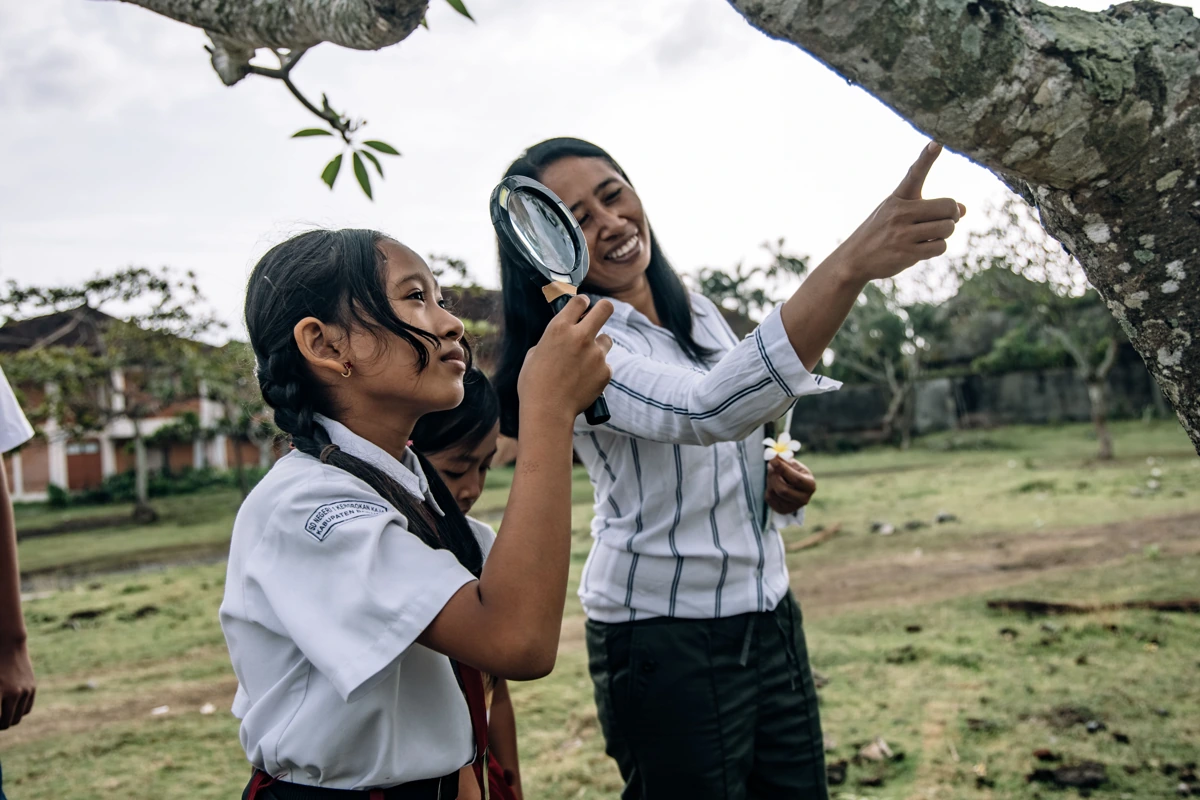
Among the implications that remain least developed is the educational one. If biophilia is genuinely innate, if children arrive in schools with a pre-existing affective orientation toward living systems, water, vegetation, and open environments, then how schools engage with or against that orientation matters enormously. The architecture of conventional schooling, with its built interiors, standardised curricula, and increasingly digital interfaces, may not merely fail to sustain children's biophilic orientation; it may actively attenuate it. Montessori education, by contrast, was designed from its inception around direct sensory engagement with natural materials, outdoor environments, and child-led inquiry. This pedagogical structure maps, whether by design or coincidence, onto the theoretical requirements of sustained biophilic development (Lillard, 2005). This review addresses the question: how do traditional and Montessori schools differ in their engagement with children's biophilic orientation, and what does the available evidence, including recent empirical data from a Montessori research programme in Hyderabad, India, tell us about the consequences of those differences for children's ecological imagination, creative expression, and long-term nature connectedness?
The review is organised as follows. Section 2 establishes the theoretical foundations of the biophilia hypothesis and its educational extensions. Section 3 surveys the literature on nature contact, biophilic design, and nature-based learning in traditional and Montessori school contexts. Section 4 examines children's drawings as an empirical window into biophilic orientation. Section
5 synthesises the Blue Blocks empirical programme as a case study. Section 6 discusses pedagogical implications and limitations. Section 7 concludes.
Theoretical Foundations
The Biophilia Hypothesis
According to Wilson’s (1984) biophilia hypothesis, humans possess emotional, attentional, and perceptual responses that have been tuned over evolutionary time to reflect conditions of survival and selection in natural environments. The inclination of humans toward water, vegetation, open prospect, living beings, and refuge does not reflect simply an arbitrary or aesthetic judgment but is rather an evolved heritage of the landscapes wherein human evolution occurred. Extending the hypothesis, Kellert (1993) elaborated nine human biophilic values that represent human relationship with the natural world from utilitarian to symbolic, and stated that artificial environments cannot compensate for these, because they fail to activate the full repertoire of evolved responses. Important adaptation of biophilia to the educational context has been made by Kahn and Kellert (2002) who emphasized the need for the availability of frequent contact with nature in all childhood periods at all levels in order to enable healthy biophilic development. In popular terms, Louv (2005) coined the phrase ‘nature-deficit disorder’ not to refer to any official diagnosis but to a concept to explain a complex range of problems such as attitudinal, emotional, and cognitive impacts associated with diminished interaction with the natural world among children. In his review, Chawla (2006) highlighted the importance of what he referred to as significant life experiences in nature as those encounters with nature that contribute to the shaping of ecological identity in long term.
For educational research, a basic prediction derived from the theory of biophilia suggests that when given a chance to engage with free form of expression and especially when children are posed an open-ended prompt, children's imaginative and creative works should tend to be about nature images, water, plants, animals by virtue of evolved orientation regardless of specific instruction or training. This prediction of the theory is yet rarely examined particularly in non-Western settings (Rao & Chakraborty, 2026a).
Jungian Archetypes as a Complementary Lens
A second theoretical school that makes similar predictions about observable phenomena comes from archetypal theory of Jung. Jung(1964) argued that a variety of images, such as water, sky, earth, trees, or light, represent universal archetypes embedded in the collective unconscious, a
structural level of mind common to all human cultures and across development. Stevens (1982) and von Franz (1964) expanded on these ideas.
Though the metaphysical propositions of Jungian theory cannot be empirically tested, a key prediction that it makes about children is the same as that of biophilia theory; namely, the high frequency and spontaneous occurrence of natural imagery (like water) among children’s imaginative creations, whether taught or not and regardless of cultural background.
The conclusion that children are not empty slates concerning their connections with the natural world comes from both theoretical perspectives: they arrive in classrooms having a ready-made imaginative structure somehow “tuned” to living things. Classrooms will facilitate that imaginative structure or hinder it.
Attrition of Biophilic Orientation with Age
One phenomenon consistently observed across the biophilia literature is that the orientation of biophilia may not be lost through development but is simply diluted as one grows up, becomes educated and more established in urban centers. Kellert (2002), Louv (2005) and Chawla (2006) had each postulated that this loss is a developmental reality, can be prevented, and represents something more sinister than natural growth. Instead, it represents the failure of urban design and school design. The Blue Blocks Biophilia Pilot Study (Rao & Chakraborty, 2026a) bears this out. Drawing in the Montessori school in Hyderabad provided a place in which exposure to and use of nature in school-based materials is intentionally encouraged compared to a conventional school, but mean biophilic element scores still showed a clear directional decrease from 6 to 8 year old children (M = 6.20), 9 to 12 year olds (M = 4.76) to 13 to 16 year olds (M = 3.62). Thus even in this less-traditional context a gradient of decline could be measured suggesting a stronger gradient might be observed elsewhere, the researchers report.
Nature Contact in Traditional and Montessori Schools
Traditional Schooling: Structure, Separation, and the Built Interior
The design of modern education systems - with their homogenous indoor classrooms, prescribed curricula, timed outdoor play, and expanding digital frontiers - constructs a structural distance between the child and nature that biophilia theorists have shown to be detrimental. The distance is
rarely imposed through intent; it's an artefact of institutional imperatives, such as standardisation, scalability, and accountability, not a thoughtful rejection of nature contact. Regardless of intent, the impact is undeniable. It's not surprising, then, to find that studies into young people’s preferences for natural settings consistently demonstrate that kids would rather play, explore, and take a break from mental exhaustion in nature-scapes (particularly water, plants, and sweeping views) than in buildings (Kaplan & Kaplan, 1989; Wells & Evans, 2003). Yet children spend most of their school hours in building-, interior-, and nature-starved schoolrooms. For children with attention problems, Taylor and Kuo (2009) documented improvements in concentration after they spent time outdoors, a result aligning both with attention restoration theory (Kaplan & Kaplan, 1989) and the broader biophilia argument: that nature can play a restorative role that nature-deficient buildings cannot.
The curriculum structure of conventional schooling also shapes the content of what children learn to associate with the natural world. In most national curricula, ecology and nature are topics within a science subject, bounded, assessed, and transmitted through text and illustration rather than direct sensory engagement. This framing communicates, perhaps inadvertently, that nature is an object of knowledge rather than a context for living, a message that the biophilia hypothesis predicts will, over time, deepen the attrition of children's affective orientation toward living systems. It is worth noting that this is not a universal diagnosis of all conventional schools. Some conventional schools integrate outdoor learning, school gardens, and nature-rich environments effectively. But these are exceptions to a structural default that is, in its general form, biophilia-attenuating rather than biophilia-sustaining.
Montessori Education: Structural Alignment with Biophilic Development
Montessori education was not designed as a biophilia programme. Maria Montessori's educational philosophy (Montessori, 1912) emerged from her observations of children's natural learning tendencies, their preference for sensory engagement, self-directed activity, and direct contact with real materials and environments. Yet the structural features of Montessori pedagogy extended outdoor time, natural materials in the classroom, emphasis on observation and direct encounter with living systems, and freedom of movement, map closely onto the conditions that the biophilia literature identifies as necessary for sustained biophilic development.
Lillard (2005), in the most comprehensive empirical review of Montessori outcomes, documented that students educated through Montessori methods show stronger connections to nature, greater observational skills, and higher levels of intrinsic motivation toward learning than students in conventional classrooms. The mechanism, consistent with biophilia, appears to be that Montessori environments sustain rather than suppress the child's existing orientation toward living systems by embedding learning within those systems rather than abstracting it from them.
Sobel (2008) articulated the principle of "place-based education", the deliberate rooting of learning in direct engagement with local environments, as a foundation for ecological empathy and long-term nature connectedness. Montessori pedagogy, with its emphasis on the child's immediate sensory environment as the primary context for learning, is structurally consonant with this principle. The biophilic implications are significant: a school that sustains children's contact with living systems through the primary and middle school years is, by the logic of the attrition hypothesis, a school that slows or reduces the developmental gradient of biophilic diminishment.
Biophilic Design in School Environments
A growing body of research on school architecture and biophilic design extends the analysis beyond pedagogy to the physical environment itself. Beatley (2011) argued that biophilic cities and, by extension, biophilic schools require the deliberate integration of living systems into built spaces: plants, water features, natural light, natural materials, and views of nature. Studies consistently find that classrooms with views of greenery, natural light, and access to outdoor spaces produce better attentional performance, lower stress, and higher academic engagement than interior, nature-poor equivalents (Wells & Evans, 2003; Kellert, 2005).
The relevance for the traditional-Montessori comparison is not absolute: a well-designed conventional school can be more biophilically rich than a poorly designed Montessori one. But the structural and pedagogical defaults of Montessori education are more likely, on average, to produce biophilically rich environments because the sensory richness of the immediate environment is, in Montessori philosophy, a foundational educational value rather than an optional add-on.
Children's Drawings as Evidence of Biophilic Orientation
Drawings as Research Instruments
The use of children's drawings as research instruments has a substantial history in developmental psychology, environmental education, and art therapy. Chambers' (1983) Draw-A-Scientist Test demonstrated that schematic drawings reliably reveal children's underlying knowledge structures and cultural assumptions. Klepsch and Logie (1982) validated drawing tasks as instruments for the study of children's mental imagery. Cox (1992) documented the developmental trajectory of children's representational drawing, establishing normative patterns of schema activation and visual content selection.
Within the biophilia literature specifically, the drawing prompt is an underused but powerful research tool. A prompt asking children to draw a place where life can exist is semantically open, it does not specify nature, city, or any particular environment and yet, as the Blue Blocks data demonstrate, the imaginative response is systematically biophilic when the sample comes from a Montessori context (Rao & Chakraborty, 2026a). The drawing task functions as a window into what Rao and Chakraborty (2026a) called the child's "early default cognitive-imaginative frame", the imaginative architecture that underlies the child's relationship with the living world before that architecture is substantially overlaid by formal instruction and urban imagery.
Prompt Effects: Ecological Prompting vs. Thematic Free Expression
One of the most significant empirical contributions of the Blue Blocks research programme is its systematic comparison of prompted and unprompted drawing conditions and their effects on ecological content. Rao, Chakraborty, and Donakanti (2026) reported data from two studies conducted at the same Montessori school: the Biophilia Pilot Study, in which 81 children were given the explicit ecological prompt "Draw a place where life can exist"; and the Drone and Art Day study, in which 93 students produced 198 drawings in a themed, unprompted session organised around the evolution of life on Earth.
The results were striking. Significant between-group differences were observed across all six shared visual elements. Prompted children included significantly more animals (38.3% vs. 5.6%),
water (54.3% vs. 20.7%), and sun/moon (59.3% vs. 21.2%) than unprompted children. The mean Shared Element Score was significantly higher under the prompted condition (M = 2.90 vs. M = 1.81; t = 5.94, p < .001). These findings were replicated in the within-subject paired subset of 53 students who participated in both studies.
The theoretical interpretation offered by the authors is consistent with the biophilia framework: the ecological prompt activates a pre-existing set of nature-related schemas what they term "phylogenetic whispers" that the unprompted condition leaves dormant. Prompt design is, on this account, a genuine pedagogical lever: teachers who wish to activate and assess children's ecological orientation should use explicit ecological prompts rather than relying on thematic framing alone. The one exception to the pattern of prompt-enhanced ecological content was sky, which appeared more frequently in unprompted drawings (61.6% vs. 23.5%). The authors interpreted this as consistent with Cox's (1992) finding that sky functions as a conventional background feature in children's drawing; its presence is a compositional default rather than an ecologically motivated choice.
Age-Related Patterns Across School Types
The Blue Blocks Biophilia Pilot Study (Rao & Chakraborty, 2026a) offers the most directly pertinent information about age-related biophilic orientation attrition in a Montessori educational setting. The negative correlation between age and biophilic elements (6-8y, M = 6.20; 9-12y, M = 4.76; 13-16y, M = 3.62) confirmed H3 prediction and matched theories of Kellert (2002), Louv (2005), Chawla (2006). Importantly, this attrition gradient was apparent within a school, which uses a teaching methodology focused on ensuring continuing exposure of children to natural elements, and therefore represents, relative to much of the existing biophilia literature, ideal conditions for children to maintain biophilic inclination.
Indeed the authors argued, if such attrition was evident in this context, it would be more pronounced in more mainstream schools which offered structurally weaker conditions for biophilic engagement.
This forms an empirical prediction that could be tested directly by a comparative study contrasting between different types of schooling (Montessori and Conventional), matching samples across school types for age, city and socio-economic status. As such, very few data currently exist
regarding a negative developmental trend in the direction found in the current study within conventional educational settings, and these existing studies have often occurred within Western settings and utilized different methodologies to the present one, and were thus not readily comparable with the Blue Blocks findings. Comparative and pre-registered re-creation with the use of the present study’s scoring system to be implemented across both conventional and non-conventional schools would, therefore, constitute a novel and meaningful addition to the literature.
The Blue Blocks Empirical Programme: A Case Study
Overview of the Research Programme
All the empirical studies described in the review were carried out at Blue Blocks Montessori School, Hyderabad, India, and are part of the research program of the Blue Blocks Micro Research Institute. The programme has several characteristics which set it apart from much empirical work on the subject, including: pre-registration of hypotheses and analysis plans before collecting any data (Chakraborty & Rao, 2026); the open publication of coded datasets on Harvard Dataverse (Rao & Chakraborty, 2026b; Chakraborty, 2026); strict adherence to purpose-made ethics and data governance standards (Blue Blocks Micro Research Institute, 2026a, 2026b, 2026c); and a clearly laid-out framework for conducting practitioner-based longitudinal educational research (Blue Blocks Micro Research Institute et al., 2026).
Three empirical outputs are directly relevant to this review. The Biophilia Pilot Study (Rao & Chakraborty, 2026a) provides a preregistered baseline on biophilic orientation in children's drawings across three age groups. The Phylogenetic Echoes paper (Rao, Chakraborty, & Donakanti, 2026) extends this work through a cross-study comparison of prompted and unprompted drawing conditions. The Supra-Nature conceptual paper (Donakanti, 2026a) introduces a new analytical category for children's imaginative departures from realistic nature in art.
The Biophilia Pilot Study
The Biophilia Pilot Study (Rao & Chakraborty, 2026a) was a single-session, group-administered descriptive study in which 81 children (aged 6–16) at Blue Blocks Montessori School were given
the prompt "Draw a place where life can exist." Drawings were coded using a preregistered scheme across five element categories (water, vegetation, animals, sky/light, built environment) by a trained primary observer, with inter-rater reliability established for 27.2% of drawings (r = 0.989 on biophilic element count). The primary finding that 77.5% of drawings were classified as predominantly or strongly biophilic, exceeding the preregistered 60% threshold, is one of the few directly quantified, preregistered tests of the biophilia hypothesis through children's spontaneous drawing in any educational context, and one of the very few in a non-Western setting. The finding that 87.7% of drawings contained at least one built element substantially exceeding the preregistered 30% threshold for H4 was initially anomalous but, on closer inspection, consistent with the urban biophilia literature: built elements appeared as secondary, embedded features within predominantly natural imagery rather than as dominant content.
The study's authors interpreted this pattern as consistent with the urban context of Hyderabad — a rapidly urbanising technology hub — and with the broader finding that children's nature connectedness is increasingly filtered through urban rather than wild nature encounters (Beatley, 2011; Soga & Gaston, 2016). For these children, 'a place where life can exist' is not a wilderness but a hybrid: gardens alongside buildings, trees framing roads, water beside constructed spaces. The phylogenetic echo, as the authors described it, is not erased by urbanisation — it is inflected by it.
Prompt Effects and the Supra-Nature Category
The Phylogenetic Echoes paper (Rao, Chakraborty, & Donakanti, 2026) introduced two contributions of particular relevance to the Montessori-traditional comparison. First, the cross-study comparison of prompted and unprompted conditions provided the first systematic empirical evidence, in any school context, of the differential activation of ecological schemas by prompt design. Second, the unprompted Drone and Art Day data introduced and empirically populated the new category of Supra-Nature.
Supra-Nature, defined as imaginative rather than representational content, including invented animals, imaginary landscapes, and sci-fi or fantasy technology, appeared in 20.7% of Drone and Art Day drawings. Crucially, the supra-natural content in these drawings was predominantly
technological and inventive rather than traditionally fantastical: imaginary creatures (8.1%), invented landscapes (6.1%), and sci-fi/tech fantasy (4.0%) were the most common elements, while mythical beings and magic/spells were entirely absent from the dataset.
Donakanti (2026a) interpreted this pattern as reflecting the technology-rich, science-forward culture of the school's context, both the Montessori STEM-arts integration and the Hyderabad environment as a technology hub. When children at Blue Blocks imagine beyond the natural world, they do so in the direction of invented futures rather than traditional fairy-tale fantasy. The Supra-Nature category is presented not as a departure from biophilia but as its creative complement: where biophilic content represents the ancestral echo of phylogenetic nature affinity, Supra-Nature represents the imaginative frontier beyond it.
The relevance of this category to the traditional-Montessori comparison is significant. A conventional school context with a less imagination-rich, less STEM-arts-integrated curriculum might be expected to produce different supra-natural content — or less of it. Whether supra-natural expression is a specifically Montessori phenomenon or a broader developmental one is an open empirical question.
Limitations of the Blue Blocks Data for Cross-School Comparison
The Blue Blocks research programme, while rigorous within its own design constraints, is explicitly limited to a single school in a single city. All participants are drawn from a Montessori population whose biophilic orientation may be higher than that of children in conventional schools precisely because of the pedagogical context. The absence of a matched conventional school comparison group means that all comparative claims in this review about Montessori versus traditional schooling are theoretically grounded but not directly supported by the Blue Blocks data themselves.
The preregistered Biophilia Pilot Study (Rao & Chakraborty, 2026a) noted this explicitly and called for replication across school types, geographic and cultural settings, and age groups with larger and more balanced samples. The Blue Blocks coding scheme — preregistered, publicly archived, and operationally detailed — is well-positioned to support such replication. This review
endorses that call and identifies the Montessori-versus-conventional comparison as the most important next empirical step in this research programme.
Discussion: Pedagogical Implications and Future Directions
Prompt Design as a Pedagogical Lever
The most immediately actionable finding from the Blue Blocks programme for educational practice concerns prompt design. The Phylogenetic Echoes study (Rao, Chakraborty, & Donakanti, 2026) demonstrated that the presence or absence of an explicit ecological drawing prompt produces large, statistically significant differences in the ecological content of children's drawings differences that hold at the group level and replicate within the paired subset of students who participated in both conditions.
For teachers in both Montessori and conventional schools, this finding has a direct pedagogical implication: if ecological imagination is an educational goal, explicit ecological prompts are a necessary tool. Thematic framing alone — however ecologically rich the theme — does not reliably activate the ecological schemas that an explicit prompt does. This is not a failure of the unprompted condition; the Supra-Nature findings suggest that the unprompted condition generates a different and equally valuable kind of creative expression. But the two conditions are not interchangeable, and teachers should be intentional about which they use and for what purpose.
Montessori as a Structural Advantage, Not a Guarantee
This article has reasoned that the Montessori system is inherently better equipped to support children’s biophilic inclination throughout the school years than mainstream schooling on the strength of its pedagogical framework: the direct tactile and sensory encounter with nature’s own materials, the use of the out of doors, teaching about the natural world in ways that draw the children to it and an educational theory which accepts that the immediate sensory life of the child is the starting ground for their learning.
However, the Blue Blocks data provided by an authentic Montessori School provide a useful qualifier of these arguments; it is possible to observe the age related decline of the children’s
inclination towards their biophilic inclination in the Montessori system as well. The gradient from the children aged between 6-8 (M = 6.20) and the older ones 13-16 (M=3.62) on the measurement of their count of the natural elements reflects a genuine decline in the expressions of the children’s relationship with the earth over the span of the school's education.
The Montessori curriculum has evidently tempered and possibly even slowed this decline, but it cannot negate it. The large-scale processes of urbanisation and social conditioning, along with the development of non-natural stimuli which have been mentioned in the writings of both Kellert (2002) and Louv (2005), have been too influential on the human child to have been contained by this approach. The practical application here appears to be that in the upper age grades, the curriculum within even an ecologically orientated Montessori school needs to be carefully considered, so as to encourage children to retain and build upon the nature-based approaches which seem to be supported in their lower age groups.
Urban Biophilia and the Hybrid Ecological Imagination
A finding of particular theoretical interest from the Blue Blocks programme is the prevalence of built environment elements in the biophilia drawings (87.7% of drawings contained at least one built element) alongside a robust overall biophilic orientation (77.5% classified as predominantly or strongly biophilic). Far from contradicting each other, these findings reveal the shape of contemporary children's ecological imagination in an urbanising context: nature and the built world are not alternatives but cohabitants in the child's imaginative landscape.
This finding resonates with the urban biophilia literature (Beatley, 2011; Soga & Gaston, 2016) and has implications for how schools in urbanising contexts, particularly rapidly growing technology cities like Hyderabad, frame the relationship between nature and the built world. A pedagogy that positions wilderness as the only legitimate form of nature contact is likely, in such a context, to communicate that nature is inaccessible rather than nearby. A pedagogy that recognises and cultivates biophilic connection within urban and hybrid environments, gardens, parks, street trees, indoor plants, and water features is more likely to sustain children's ecological orientation through the years of urbanisation.
Directions for Future Research
This review identifies several high-priority directions for future research:
A preregistered comparative study applying the Blue Blocks drawing task and coding scheme to matched samples of children in Montessori and conventional schools in the same city, controlling for age, socioeconomic context, and nature exposure outside school.
A longitudinal within-subject replication tracking the same children's biophilic drawing orientation across the school years, ideally across the transition from primary to secondary education, to better characterise the developmental attrition gradient.
Replication of the Blue Blocks biophilia and prompt-effect studies in non-Montessori, non-Indian contexts to establish the cross-cultural and cross-pedagogical generalisability of the findings.
Experimental studies manipulating prompt design within the same school to establish the causal effect of ecological prompting on biophilic expression, rather than relying on between-study comparisons.
Investigation of the Supra-Nature category in conventional school contexts, to establish whether the technology-forward imaginative departures observed in the Blue Blocks data are specific to the Montessori STEM-arts context or reflect a broader developmental pattern.
Conclusion
The biophilia hypothesis predicts that children arrive in schools with a pre-existing affective orientation toward living systems, an orientation that is phylogenetically embedded and that education can either sustain or attenuate. The evidence reviewed here, drawing on Wilson (1984), Kellert (1993, 2002, 2005), Louv (2005), Chawla (2006), and the emerging Blue Blocks empirical programme, supports three broad conclusions. First, structural and pedagogic aspects of Montessori learning appear better matched than those of mainstream schooling to the preconditions the biophilia literature identifies as required to sustain the development of biophilic dispositions: interaction with nature in natural materials, substantial outdoor engagement, and a pedagogy grounded in the child's local environment as primary habitat and context. Standard
school practice, generally in structure, as opposed to potentially a given school, either inside Montessori or the mainstream, is biophilia attenuating, not sustaining. Second, children's drawing, at least under open-ended ecological prompts, provides a legitimate, sensitive and conveniently available source of empirical insight into their biophilic disposition. It is illustrated using the Blue Blocks research evidence that such insight can be systematically obtained, based on preregistered hypotheses, and with systematic coding, and public archiving, for purposes of transparency, replicability and pedagogic relevance. Third, prompt design is itself a non-trivial pedagogical lever. Explicit ecological prompts activate a richer and more diverse ecological schema than thematic unprompted conditions, while unprompted conditions reveal a different and equally significant form of ecological imagination, including the new category of Supra-Nature, in which children's imaginative departures from realistic nature reveal the direction in which their inventive minds project the future of life. The phylogenetic echo of Wilson's biophilia is not silent in children's classrooms. But whether it is heard, amplified, or progressively muffled across the school years depends substantially on the educational environments those classrooms create. The design of those environments, and the design of the prompts within them, is a choice that educators make, often without realising their ecological significance. This review suggests that they should.
Declarations
Conflict of Interest: The authors are affiliated with the Blue Blocks Micro Research Institute, and Section 5 reviews a body of empirical work produced by the Institute, several outputs of which are authored by members of the present author team. The authors have no financial or commercial competing interests. This self-referential scope is acknowledged, and the in-house evidence is presented together with its stated limitations (see Section 5.4).
Ethics: This is a narrative review of published literature. No new human participants were recruited. All empirical studies cited from the Blue Blocks programme were conducted in compliance with the Blue Blocks Micro Research Ethics Framework (MREF v1.0; Blue Blocks Micro Research Institute, 2026a).
Data Availability: All Blue Blocks datasets cited in this review are publicly available on Harvard Dataverse and Zenodo. DOI references are provided in the reference list below.
References
Beatley, T. (2011). Biophilic cities: Integrating nature into urban design and planning. Island Press.
Blue Blocks Micro Research Institute. (2026a). Micro Research Ethics Framework (MREF v1.0): An ethics standard for embedded educational research by Blue Blocks Micro Research Institute. Zenodo. https://doi.org/10.5281/zenodo.19047669
Blue Blocks Micro Research Institute. (2026b). Blue Blocks Embedded Observation Protocol (BEOP v1.0): A standard for practitioner-led observation in educational settings. Blue Blocks Micro Research Institute. https://doi.org/10.5281/zenodo.19087415
Blue Blocks Micro Research Institute. (2026c). Child Data Classification Standard (CDCS v1.0): A data governance standard for child development research. Blue Blocks Micro Research Institute. https://doi.org/10.5281/zenodo.19202499
Blue Blocks Micro Research Institute, Goyal, P., Chakraborty, S., & Ediga, S. (2026). Blue Blocks Micro Research Methodology: A Practitioner-Led, Longitudinal Framework for Embedded Educational Research. Zenodo. https://doi.org/10.5281/zenodo.18584816
Chakraborty, S. (2026). Prompted Ecological Drawing Versus Thematic Free Expression in Montessori Children Aged 5–15: A Comparative Study Across Prompted and Unprompted Conditions — Dataset (2.0) [Data set]. Harvard Dataverse. https://doi.org/10.7910/DVN/8DMD5R
Chakraborty, S., & Rao, S. (2026). Drawing Life: Spontaneous Biophilic Imagery in Children's Responses to an Open-Ended Prompt — A Pilot Study [Preregistration]. OSF. https://doi.org/10.17605/osf.io/f296r
Chambers, D. W. (1983). Stereotypic images of the scientist: The Draw-A-Scientist Test. Science Education, 67(2), 255–265.
Chawla, L. (2006). Learning to love the natural world well enough to protect it. Barn, 2, 57–78.
Cox, M. (1992). Children's drawings. Penguin.
Donakanti, V. S. (2026a). Nature vs. Supra-Nature: How Montessori Children Conceptualise the Real and Imaginary Through Visual Art (1.0). Blue Blocks Micro Research Institute. https://doi.org/10.5281/zenodo.20406479
Donakanti, V. S. (2026b). Nature vs. Supra-Nature: How Montessori Children Conceptualize the Real and Imaginary Through Visual Art — Dataset (1.0) [Data set]. Blue Blocks Micro Research Institute. https://doi.org/10.5281/zenodo.20406121
Jung, C. G. (1964). Man and his symbols. Doubleday.
Kahn, P. H., & Kellert, S. R. (Eds.). (2002). Children and nature: Psychological, sociocultural, and evolutionary investigations. MIT Press.
Kaplan, R., & Kaplan, S. (1989). The experience of nature: A psychological perspective. Cambridge University Press.
Kellert, S. R. (1993). The biological basis for human values of nature. In S. R. Kellert & E. O. Wilson (Eds.), The biophilia hypothesis (pp. 42–69). Island Press.
Kellert, S. R. (2002). Experiencing nature: Affective, cognitive, and evaluative development in children. In P. H. Kahn & S. R. Kellert (Eds.), Children and nature (pp. 117–151). MIT Press.
Kellert, S. R. (2005). Building for life: Designing and understanding the human-nature connection. Island Press.
Kellert, S. R., & Wilson, E. O. (Eds.). (1993). The biophilia hypothesis. Island Press.
Klepsch, M., & Logie, L. (1982). Children draw and tell: An introduction to the projective uses of children's human figure drawings. Brunner/Mazel.
Lillard, A. S. (2005). Montessori: The science behind the genius. Oxford University Press.
Louv, R. (2005). Last child in the woods: Saving our children from nature-deficit disorder. Algonquin Books.
Montessori, M. (1912). The Montessori method. Frederick A. Stokes.
Rao, S., & Chakraborty, S. (2026a). Drawing Life: Spontaneous Biophilic Imagery in Children's Responses to an Open-Ended Prompt — A Pilot Study from Blue Blocks Montessori School. SSRN. https://ssrn.com/abstract=6638898
Rao, S., & Chakraborty, S. (2026b). Drawing Life: Spontaneous Biophilic Imagery in Children's Responses to an Open-Ended Prompt — A Pilot Study from Blue Blocks
Montessori School, Hyderabad, India (Dataset) [Data set]. Harvard Dataverse. https://doi.org/10.7910/DVN/AWUK3Z
Rao, S., Chakraborty, S., & Donakanti, V. S. (2026). Phylogenetic Echoes in Children's Art: Biophilia, Supra-Nature, and the Role of Prompt in Ecological Drawing (1.0). Research Square. https://doi.org/10.21203/rs.3.rs-9833827/v1
Sobel, D. (1993). Children's special places: Exploring the role of forts, dens, and bush houses in middle childhood. Zephyr.
Sobel, D. (2008). Childhood and nature: Design principles for educators. Stenhouse Publishers.
Soga, M., & Gaston, K. J. (2016). Extinction of experience: The loss of human-nature interactions. Frontiers in Ecology and the Environment, 14(2), 94–101.
Stevens, A. (1982). Archetypes: A natural history of the self. Routledge.
Taylor, A. F., & Kuo, F. E. (2009). Children with attention deficits concentrate better after walk in the park. Journal of Attention Disorders, 12(5), 402–409.
von Franz, M.-L. (1964). The process of individuation. In C. G. Jung (Ed.), Man and his symbols (pp. 158–229). Doubleday.
Wells, N. M., & Evans, G. W. (2003). Nearby nature: A buffer of life stress among rural children. Environment and Behavior, 35(3), 311–330.
Wilson, E. O. (1984). Biophilia. Harvard University Press.