Biomimicry Methodology for K-10: The Blue Blocks Canon Project
Sandhya Rao, Pavan Goyal, Munira Hussain Kagalwalla
- DOI
- 10.5281/zenodo.23795338
- Type
- Published Record
Abstract
This paper sets out the Blue Blocks methodology for teaching biomimicry from early childhood through adolescence (K-10, ages 1 to 16). It argues that the naturalist mindset and skillset needed to learn from nature should be nurtured from the earliest years, and that children should be designing and prototyping from as young as six, when they are high on imagination. The methodology rests on three foundations, Biology, Biomimicry and Biophilia, and is situated within Montessori education, with Cosmic Education as the thread that connects Montessori education and biomimicry. It describes a developmental progression in four stages: sensorial foundations (0 to 6), observing and mimicking nature (6 to 9), solving problems the way nature does (9 to 12), and the full design cycle (12 to 18). The paper then sets out the curriculum framework, the Biomimicry Journal and materials, and the whole-school structures that sustain the approach: the Biomimicry Hive, the Montessori Farm, a network of experts and a children’s Seed Bank. All of this is held by one Ethos of Respect, Responsibility and Regeneration.
Keywords: biomimicry; Montessori; Cosmic Education; biophilia; naturalist intelligence; design thinking; K-10; innovation education
1. Introduction
Nature is the mother of invention. Many familiar inventions mimic designs found in nature, and this practice of learning from living systems is known as biomimicry (Benyus, 1997; Vincent et al., 2006).
However, most inventions using biomimicry have been created by engineers or companies who invest heavily in research and development, mostly to increase the efficiency of an existing product or design. For them, being symbiotic with nature is not a way of life.
This paper asks a different question: what if this thinking were ingrained within primary education itself, so that children start relating to nature, see how it is interconnected, and start creating designs that can enhance life? This is the endeavour of Blue Blocks, a K-12 school in Hyderabad, which has created a biomimicry lab within the school premises so that children can understand, experiment and learn using nature as inspiration. The sections that follow set out the foundations, philosophy, developmental progression, pedagogy and school-wide structures of that methodology.
2. Conceptual Foundations: Biology, Biomimicry and Biophilia
The methodology rests on three related ideas. Biology tells children what living systems are, biomimicry asks what we can learn from them, and biophilia is the affinity that makes children want to look in the first place.
2.1 Biology
Bio means life, or living systems. Biology is the area of study in which we learn about living organisms and systems, and the relationships between biotic and abiotic factors.
2.2 Biomimicry
Biomimicry is learning from living organisms, living systems, and both biotic and abiotic factors. Nature is a vast source of inspiration and solutions, with strategies for the challenges humanity faces. By mimicking nature’s designs and processes, we can innovate solutions for the challenges of these times (Pawlyn, 2011).
The word itself brings together bios, meaning life, and mimesis, meaning to imitate. It invites us to look at nature not merely as something beautiful to admire, but as a remarkable teacher, a source of inspiration, and a living laboratory of solutions.
Nature, with its accumulated wisdom of around 3.8 billion years, has long grappled with and overcome numerous challenges that confront humanity today (Benyus, 1997). Human beings are relatively recent additions to this vast and time-tested ecosystem, and we have much to learn from nature’s ingenuity.
2.3 Biophilia
Biophilia is the natural affinity that people have towards the nature around them (Wilson, 1984; Kellert & Wilson, 1993; Kahn & Kellert, 2002). Children are born nature lovers, and it is nature which nurtures young brains the most (Sobel, 1996; Chawla, 2015). This innate affinity is the ground on which the rest of the methodology is built.
2.4 Why Biomimicry: Learning from the Natural World
Everybody learns from biology, but appreciation comes when we look at what the natural world has to offer us: its design, its leadership stories, its structures, its geometry, its art and its physics. Taken in its totality, the natural world nurtures many different kinds of thinking, including systems thinking, interdependent thinking and cause-and-effect thinking. It is also the best way for children to interconnect all their subjects, and to learn and observe (Kuo et al., 2019).
This is why biomimicry is an integral part of learning at Blue Blocks. Biomimicry is usually offered to graduate students in universities and colleges, but Blue Blocks believes it can begin at school, at the age of six, with basic foundations. All it takes is to draw children’s attention to the details of what they observe around them, and to give them observation tools that strengthen their research skills.
3. Philosophy and Intent: The Naturalist Mindset and Skillset
The intent of introducing biomimicry is to develop a naturalist and innovative mindset and skillset in every child.
According to Pavan Goyal, Founder of Blue Blocks, a naturalist skillset and mindset is something a young child needs to be nurtured with. Whatever the challenge tomorrow, be it in a boardroom or in designing something for humankind, children should be able to draw on it. Children should make something, a prototype, as young as six, when they are high on imagination, and not wait until they grow into adults.
The founders of Blue Blocks, Pavan Goyal and Munira Hussain Kagalwalla, believe that children can innovate. The innovation mindset and skillset can be nurtured from as young as six, when children’s imagination, reasoning and intellectual minds are growing. We do not have to wait until children grow up for them to innovate. At six they can begin with simple skills: observation, documentation, research, prototyping, 2D and 3D sketching, testing and evaluation, moving through different design-thinking processes (Brown, 2008) at various stages as part of their own learning, and as an extension of what they learn in their Montessori environments.
Children are born with a naturalist intelligence (Gardner, 1999), and it needs to be nurtured. In Pavan Goyal’s words:
“We are always looking for ways to ensure that our education doesn’t stay just within the books and instead is symbiotic with the world around them. And especially in today’s world, understanding, protecting, and living with nature is amongst the most important lessons that we need to teach our children.”
Sandhya Rao, the biomimicry expert who heads the programme at Blue Blocks, explains why the approach begins so early: “Biomimicry works beautifully with young children, because they have the willingness to pause, wonder, appreciate and understand the nature around them.”
Blue Blocks holds that great learning inculcates curiosity, creativity, enterprise and problem-solving, all essential life skills. Here, learning uses nature to inspire innovation.
3.1 Mindset
The mindset includes, but is not limited to:
- Imagination
- Thinking and empathy
- Assessing nature around us: an enquiring, reasoning mind (for example, counting the rings of a tree log to know its age and the seasons it has gone through)
- Understanding functions and strategies in nature
- Understanding the interdependencies and interconnections in nature
- Curiosity and critical thinking
3.2 Skillset
The skillset includes, but is not limited to:
- Observation
- Recording: sketching, journal writing, story writing, measuring
- Finding patterns and sensorial awareness
- Prototyping
- Researching, comparative study, analysing and concluding
3.3 A Co-founder’s Perspective
Munira Hussain Kagalwalla, Co-founder of Blue Blocks, describes what this work ultimately seeks:
“When we teach children to learn from nature, we also teach them to care for nature. When wonder becomes understanding, and understanding becomes respect, we lay the foundations for a generation that will not only imagine a better world, but will also have the wisdom and the responsibility to create it.”
3.4 From Seeing Nature to Reading It
The aim is for children to move beyond simply seeing nature to truly reading it: recognising patterns, understanding relationships, and discovering the intelligence embedded in the natural world. When children observe natural phenomena scientifically, observation turns into problem-solving. They begin to ask not only “How does this work?” but also “What can we learn from this? How might we use this idea to solve a problem?” Over time they develop a disposition to turn to nature for inspiration, approaching challenges with curiosity, resourcefulness and an open mind.
A simple observation of a seed, a bird’s nest or an insect’s wing can become the beginning of an idea, an invention or an entirely new way of thinking.
4. Montessori, Cosmic Education and Biomimicry
Biomimicry at Blue Blocks is not an add-on to the curriculum. It grows out of the Montessori environment, and Cosmic Education is the thread that connects the two.
4.1 The Montessori Environment
At Blue Blocks, education has never been prescriptive; children are encouraged to understand and apply their learning by doing (Dewey, 1938; Lillard & Else-Quest, 2006; Lillard, 2017). The Montessori environments, from the sensorial work of the early years to the elementary classroom, nurture the different kinds of thinking, the mindset and the skillset that children need to love and learn the perspective of biomimicry. The Blue Blocks Montessori Farm extends that environment outdoors.
4.2 Cosmic Education as the Connecting Thread
In Montessori elementary education, Cosmic Education presents the universe, the Earth and life on it as one interconnected whole, in which every living thing has its place and its work (Montessori, 1948). Biomimicry asks children to see nature in exactly this way: as a web of organisms, systems, and biotic and abiotic factors, each with strategies refined over 3.8 billion years.
Biomimicry also honours the intellectual needs of the child. Children are drawn to the extraordinary, the complex and the interconnected; they want to know how things work, why they are the way they are, and how everything fits together. Discovering the ingenious strategies of living organisms feeds this intellectual hunger while giving flight to their imagination.
Cosmic Education is therefore the thread that runs from the Montessori environment to biomimicry. It gives children the big picture of how nature is interconnected, and biomimicry turns that understanding into observation, enquiry and design.
4.3 An Interdisciplinary Subject
Biomimicry, while being a subject by itself, is also a combination of physics, chemistry, geography, engineering, mathematics, geometry, history and art. It is a deeply interdependent subject, and every subject can be integrated with it. Like Cosmic Education, it draws the disciplines together around a single question: what can we learn from the living world?
5. Developmental Progression
Biomimicry is offered as a progression across four stages. Each builds on the one before: from sensing nature, to observing and mimicking it, to solving problems the way nature does, to running the full design cycle, all held by one Ethos of Respect, Responsibility and Regeneration.
5.1 Ages 0 to 6: Sensorial Foundations
The years from 0 to 6 lay the foundations of sensorial exploration (Montessori, 1967). Children are born nature lovers with a naturalist intelligence, and at this age it is nature which nurtures the young brain the most.
Children explore nature through all five senses. Through this sensorial work, and through meeting farm animals, colourful flowers, birds, fish and the sounds of nature, they build their knowledge of the world around them. This sensorial knowledge is the ground on which observation, recording and design are built in the elementary years.
5.2 Ages 6 to 9: Observing and Mimicking Nature
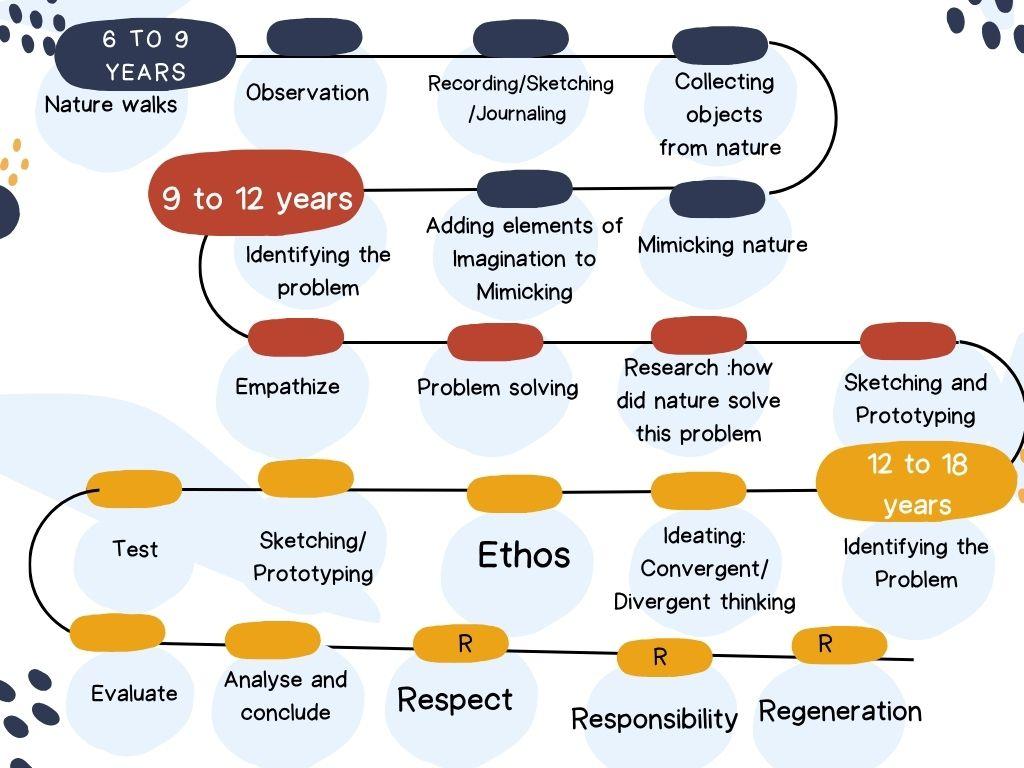
At 6 to 9, children go out into nature, observe it closely, record what they see, and begin to mimic it. This is the age when they are high on imagination, so this is where making begins. The stage proceeds as follows:
- Nature walks
- Observation
- Recording, sketching and journaling
- Collecting objects from nature
- Mimicking nature
- Adding elements of imagination to mimicking
5.2.1 Mimicking nature as it is
At this age, children mimic the parts of nature as they are. They might:
- Collect grass and the other materials needed to make a nest, and learn how birds achieve such an intricate design
- Weave a web like a spider, studying the geometry behind it
- Learn origami, cutting and folding models from forms found in nature
Through direct imitation, children come to understand how nature builds before they are asked to apply it.
5.2.2 Observing an animal, insect or bird
There are many animals and birds in and around our homes which visit us daily, and some are seasonal visitors, for example cats, frogs, butterflies, honeybees, dogs, crows, sparrows, woodpeckers and ducks. Children keep three things in mind:
- Our local friends. First, make a list of the animals, birds or insects that frequently visit or live in the locality. This helps children choose what to observe and what is accessible, and they are often surprised how many are out there. Before beginning, children practise the art of staying very quiet, as these creatures are easily disturbed, and keep all their senses open to capture everything they see, smell, hear and feel.
- Start simple. Start from simple things, like a low-hanging fruit or flower in the garden or the trees around, and see who visits them at different times of the day: squirrels, rats or mice, crows, sparrows. Small animals give us big lessons, as their behaviours are sometimes the same as those of big animals.
- Seasonal behaviours. Note the current season. As seasons change, children might observe changes in the animals or birds they are watching: there may be more of them as they give birth to young ones, they might be busy building homes or nests, or they may change their food preferences.
5.3 Ages 9 to 12: Solving Problems the Way Nature Does
At 9 to 12, children move from mimicking nature to identifying a problem, empathising with those it affects, and researching how nature has already solved it, before sketching and prototyping their own solution:
- Identifying the problem
- Empathising
- Problem-solving
- Research: how did nature solve this problem?
- Sketching and prototyping
5.3.1 From strategy to application
Children at 9 to 12 move beyond imitation to ask where a strategy in nature could solve a problem, and how it could be applied. For example: how, or where, could we use the echolocation of bats (Griffin, 1958)? Where could we use surfaces like the lotus leaf (Barthlott & Neinhuis, 1997)? The question shifts from “How does nature do this?” to “Where else could this work?”
5.4 Ages 12 to 18: The Full Design Cycle
At 12 to 18, adolescents run the full cycle on their own problems:
- Identifying the problem
- Ideating: convergent and divergent thinking
- Sketching and prototyping
- Testing
- Evaluating
- Analysing and concluding
6. Pedagogical Framework
The progression is delivered through a curriculum of categories that move children from understanding nature, to exploring it with all their senses, to designing with it. Each category is recorded in the child’s Biomimicry Journal.
The framework shown in Figure 1 is an original Blue Blocks model. It traces one continuous path from nature walks at 6 to analysis and conclusion in adolescence, with the Ethos of Respect, Responsibility and Regeneration at its centre.
Figure 1. The Blue Blocks biomimicry pedagogical framework.
6.1 Curriculum Categories
6.1.1 Understanding biomimicry
- Introduction: biomimicry, ecological balance, why biomimicry
- Stories of biomimicry: great innovations inspired by nature, with examples
- Observing and recording: techniques to observe (aerial view, zooming in and out, different angles), and what, where, when and why
6.1.2 Exploring nature (all age groups, 1 to 18 years)
- Multisensorial: the child exploring nature through the tactile, auditory, baric, thermic, olfactory and gustatory senses
- Mapping: capturing nature through mapping with different senses
- Sensorial powers of birds and animals: what nature has that humans do not possess
- Gamification: games played by animals and birds in their natural habitats
- Communication: language among birds and animals, why they communicate, and what we can learn from nature’s way of communicating
- Order in nature: stages of growth, seasonal changes, migration of birds and animals
- Patterns in nature: comparing leaves, flowers, bark, branching and stages of growth from seed to sprout to plant, between different trees and within the same tree
- Story writing: how I see the world as my favourite animal, bird, plant or season, sketched or written
- Art and craft: sketching techniques
- How does nature solve its own problems? For example:
- Self-cleaning of flowers
- How do crows alert other crows and their surroundings when there is danger from predators?
- How do honeybees remember their hives? Are they good navigators? (von Frisch, 1967)
- Venus flytraps may record the touches of potential prey to identify insects worth digesting, and then release digestive enzymes (Böhm et al., 2016)
- How do dolphins sense danger in sea waters?
- How do plants share nutrients with other plants that have a nutrition deficit? (Simard et al., 1997)
- Self-healing and care in nature: how nature heals itself, and how living things take care of each other in need
6.1.3 Designing with nature, by age group
Ages 6 to 9: mimicking nature as it is.
- Design for nature: a biomimetic bird house or nest, and a bird feeder made with natural elements
- Mimicking parts of nature as they are: collecting grass and materials to build a nest, weaving a web like a spider while studying its geometry, cutting and folding origami models
- Tools used by nature: the body parts animals, birds and insects use as tools, such as beaks, claws and feathers, and whether we can make such tools ourselves
Ages 9 to 12: from strategy to application.
- Biomimetic solutions: solutions for human problems with nature-like thinking, for example lighting for night-time motorbike and bicycle riders
- Where can it be applied? How, or where, could we use the echolocation of bats, or surfaces like the lotus leaf?
- Inspirations from nature: hexagon-shaped rooms inspired by the honeycomb (Hales, 2001); finding similarities in shapes, patterns and functions in nature
- Reverse thinking: looking at an object and asking what inspired it, for example sheep wool or polar bear fur and insulation
- Experiments
Ages 12 to 18: the full design cycle.
- Ideation cards and problem-solving statements
- Identifying a problem, ideating with convergent and divergent thinking, sketching and prototyping, testing, evaluating, and analysing and concluding
6.2 Multisensorial Learning and the Spectrogram
Nature is multisensorial, and so is the programme: vision, hearing, smell, taste, and the thermic and baric senses. One tool trains the visual brain with sound. A spectrogram is a picture, or pattern, of a sound. Children play a spectrogram, observe and identify its patterns, and match bird cards to those patterns, using resources such as the Cornell Lab of Ornithology’s Bird Song Hero (Cornell Lab of Ornithology, n.d.). They listen to music and draw its patterns, associating sounds with shapes and colours, and make sound maps of their surroundings. In doing so they learn the nature of noises in the wild: happy, sad, stressed, or needing help.
6.3 Learning with Nature: Guiding Questions
The programme poses questions that send children back outdoors:
- Have you ever wondered why birds don’t bump into spider webs?
- Have you seen how centipedes and millipedes move in a wavy manner, or how their bodies curl up?
- Have you ever wondered why bark peels off a tree?
- Why do certain birds migrate from one continent to another in particular seasons, and for what?
- How old is a tree? Count the rings of a log (Fritts, 1976).
- Try talking to plants.
- What kind of tools did ancient people make from nature for their survival?
- Why do some flowers bloom only in the evening? Why do crickets, owls and bats roam around only at night?
- Where do monkeys stay when it rains? Why do crabs walk sideways?
- How are dogs trained for security (sniffer) work, and how do they understand when we talk?
- Cattle, our farming hero: how do cows, oxen, bulls and buffaloes help in farming, and why is cow dung good manure?
- Earthworm, our soil hero: make organic compost from vegetable waste and watch earthworms make the soil fertile (Darwin, 1881).
- Butterflies and frogs are indicators: when they are present, the nature around us is healthy.
- There is so much rain throughout the year; how do we preserve it for our survival?
- From bud to bloom, is that an order? Why is everything seasonal? Mangoes and melons come in summer, citrus and guava in the rains and winter, and farmers wait for certain rains for certain crops.
- How does nature adapt to changes?
6.3.1 The educator as storyteller
It is the educator’s work to bring these intriguing questions, build their own stories around them, and prepare for and come to every session as a storyteller of the truths of nature. Creating this curiosity is very important: it is what sends children back outdoors to look for themselves (Louv, 2005).
As Montessori guides, our task is not to give children all the answers, but to prepare the conditions in which they can discover them for themselves: opportunities to observe closely, ask meaningful questions, experiment, make connections, and translate their discoveries into purposeful action.
6.3.2 Create with nature
Each child identifies an interesting piece of nature and its special features, then finds out whether an invention with similar functions already exists. If it does, they modify it into their own invention; if not, they make an invention that is useful for themselves. They then write an advertisement for it and try selling its features to a family member.
6.4 The Biomimicry Journal
Every child keeps an age-specific Biomimicry Journal, also called My First Innovation Book. It is designed for the range of recording the programme asks for:
- Textured papers, coloured papers and papers of different shapes
- Origami papers
- Papers for sketching and recording observations
- Sound maps
- Spectrogram sheets and music sheets
6.5 Materials: The Nature Observation Toolkit
When children go out into nature to observe, each carries a small toolkit:
- A magnifying glass, to look closely
- Binoculars, to see things from far away
- A torch
- A collection box
- Tongs, to pick up samples where needed
- A small journal and stationery
- A whistle, to alert each other on group nature walks
6.6 Adapting the Methodology for Remote Learning: The Square Wheel Module
During the COVID-19 period, when children could not come to school or go out on group nature walks, Blue Blocks adapted the methodology into Square Wheel, an online module. It showed that the approach can travel beyond the school campus: children observed nature around their own homes, guided by a mentor online, with a box of materials delivered to them. Each child received the Biomimicry Journal (My First Innovation Book), a self-assembling Velcro bag, a magnifying glass, stationery, a soil pack with seeds and a pot, and a bird house building kit with bird feeder material and manuals. The structure of the module is summarised in Table 1.
| Element | Format |
|---|---|
| Module | 10 sessions on Zoom |
| Session length | 60 minutes, with a mentor |
| Schedule | Weekends (Saturday and Sunday) |
| Group size | 5 to 10 children |
| Age groups | 6 to 9, 9 to 12, 12 to 15 years |
Table 1. Structure of the Square Wheel online module.
7. Whole-School Implementation
At Blue Blocks, biomimicry is a whole-school approach rather than a one-off activity. It has a dedicated space, a farm, a network of experts and a seed bank run by children.
7.1 The Biomimicry Hive
Innovation is the cornerstone and an integral part of the education model at Blue Blocks. The biomimicry corner, called and trademarked the Biomimicry Hive, is part of the larger innovation lab, which hosts numerous other ventures. The innovation lab is an arena for experiments and creativity.
The Hive is a hexagonal space inspired by beehives. Its activities encourage children to explore, study, research, and find answers to current and future problems using nature. Here children learn observation and journaling skills, understand the interdependencies and interconnections in nature, find patterns, and develop sensorial awareness, empathy, curiosity, investigative ability, and an enquiring, reasoning and critical-thinking mind.
Prof. Srikar of the Department of Design, IIT Hyderabad, designed the space alongside the Blue Blocks team, inspired by beehives and so derived from biomimicry itself. In his words:
“The space should ignite a sense of curiosity among children. Also a sense of discovery, observe nature more deeply to harness solutions for day to day problems. This lab will act as a spring board for children at a very young age, to tinker, experiment, build prototypes and learn from nature, which will go a long way as they pursue their passion domains in the future.”
7.2 The Montessori Farm and Natural Spaces
Children experience nature first-hand at the Blue Blocks Montessori Farm, a vast plantation with diverse flora and fauna. They also explore natural spaces in and around the city.
7.3 Working with Experts
As Sandhya Rao, the biomimicry expert who heads the programme at Blue Blocks, observes:
“As a part of this program, the children also get to work with expert ornithologists, herpetologists, ecologists, ethologists, botanists, geologists and pedologists, which will open up a completely different way of thinking for them not to mention the exposure it provides.”
7.4 The Seed Bank
The children created a Seed Bank of 100 different kinds of seeds they collected. The seeds were sun-dried to preserve them and stored in seed jars. Each jar is catalogued with the seed name, the best seasons to grow it, the life span of the plant, and the favourable conditions and places where the seeds can be found.
Children can use these seeds to conduct research, or share them with farmers or anyone else who can create further value from them. The Bank is managed by the children, and a prime objective is to learn how to preserve seeds for future generations, a great need of the hour.
7.5 Innovation as a Way of Life
Biomimicry is not a new concept for the children of Blue Blocks, who have already used it to create drones inspired by dragonflies. Some of the children’s drone designs are patent-pending.
8. The Ethos: Respect, Responsibility, Regeneration
Every stage of the progression, from the first sensorial encounter with nature to an adolescent’s final analysis, is held by one Ethos of three Rs:
- Respect: understanding, protecting and living with nature, and learning from its 3.8 billion years of wisdom rather than only extracting from it.
- Responsibility: children who manage their own Seed Bank and care for living things grow into responsible, thinking future citizens.
- Regeneration: preserving seeds for future generations, enriching soil with compost and earthworms, and designing solutions that enhance life.
When children recognise the intelligence, diversity, resilience and interdependence of the natural world, nature ceases to be merely a resource for human use and becomes something worthy of respect, care and gratitude. Children come to understand that human beings are not separate from the natural world, nor its masters, but participants in a much larger web of life. This nurtures the custodians of nature the world urgently needs: people who protect the Earth not because they have been instructed to, but because they have developed a deep appreciation for its wonder, its wisdom and its generosity (Carson, 1965).
A sense of gratitude and humility grows from this work. When children discover how much we can learn from a leaf, how much we can admire in a bird, or how many problems nature has already solved, they realise how much there is to learn, and that human ingenuity often begins by paying attention to what already exists around us.
8.1 Beyond Sustainability: Regeneration
The whole world talks about sustainability, which means sustaining whatever we have (UNESCO, 2017). Sustainability alone is not enough. As citizens of the future, young children and growing adolescents need the seed of regeneration planted in them: restoring and living in a place in a way that makes it workable for all the other organisms that live with us (Reed, 2007; Mang & Reed, 2012). The natural world is already doing its part. How much we, as humans, reflect on regeneration is something for us as educators to think about and question.
9. Conclusion
The Blue Blocks methodology treats biomimicry not as a specialist activity for engineers but as a way of thinking that can be nurtured from birth. It begins with the senses in the early years, grows through observation and mimicry, matures into problem-solving the way nature does, and culminates in the full design cycle in adolescence. Montessori environments and Cosmic Education give children the big picture of an interconnected world; biomimicry turns it into enquiry and design.
For the children, this is an exciting and wondrous way to discover the world around them and create a relevant and sustainable relationship with nature. For Blue Blocks, it is the joy of creating responsible, thinking future citizens.
References
Barthlott, W., & Neinhuis, C. (1997). Purity of the sacred lotus, or escape from contamination in biological surfaces. Planta, 202(1), 1–8.
Benyus, J. M. (1997). Biomimicry: Innovation inspired by nature. William Morrow.
Böhm, J., Scherzer, S., Krol, E., Kreuzer, I., von Meyer, K., Lorey, C., Mueller, T. D., Shabala, L., Monte, I., Solano, R., Al-Rasheid, K. A. S., Rennenberg, H., Shabala, S., Neher, E., & Hedrich, R. (2016). The Venus flytrap Dionaea muscipula counts prey-induced action potentials to induce sodium uptake. Current Biology, 26(3), 286–295.
Brown, T. (2008). Design thinking. Harvard Business Review, 86(6), 84–92.
Carson, R. (1965). The sense of wonder. Harper & Row.
Chawla, L. (2015). Benefits of nature contact for children. Journal of Planning Literature, 30(4), 433–452.
Cornell Lab of Ornithology. (n.d.). Bird Song Hero. Bird Academy. https://academy.allaboutbirds.org/features/bird-song-hero/bird-song-hero-tutorial
Darwin, C. (1881). The formation of vegetable mould through the action of worms, with observations on their habits. John Murray.
Dewey, J. (1938). Experience and education. Macmillan.
Fritts, H. C. (1976). Tree rings and climate. Academic Press.
Gardner, H. (1999). Intelligence reframed: Multiple intelligences for the 21st century. Basic Books.
Griffin, D. R. (1958). Listening in the dark: The acoustic orientation of bats and men. Yale University Press.
Hales, T. C. (2001). The honeycomb conjecture. Discrete & Computational Geometry, 25(1), 1–22.
Kahn, P. H., Jr., & Kellert, S. R. (Eds.). (2002). Children and nature: Psychological, sociocultural, and evolutionary investigations. MIT Press.
Kellert, S. R., & Wilson, E. O. (Eds.). (1993). The biophilia hypothesis. Island Press.
Kuo, M., Barnes, M., & Jordan, C. (2019). Do experiences with nature promote learning? Converging evidence of a cause-and-effect relationship. Frontiers in Psychology, 10, 305.
Lillard, A. S. (2017). Montessori: The science behind the genius (3rd ed.). Oxford University Press.
Lillard, A., & Else-Quest, N. (2006). Evaluating Montessori education. Science, 313(5795), 1893–1894.
Louv, R. (2005). Last child in the woods: Saving our children from nature-deficit disorder. Algonquin Books.
Mang, P., & Reed, B. (2012). Designing from place: A regenerative framework and methodology. Building Research & Information, 40(1), 23–38.
Montessori, M. (1948). To educate the human potential. Kalakshetra Publications.
Montessori, M. (1967). The absorbent mind (C. A. Claremont, Trans.). Holt, Rinehart and Winston. (Original work published 1949)
Pawlyn, M. (2011). Biomimicry in architecture. RIBA Publishing.
Reed, B. (2007). Shifting from “sustainability” to regeneration. Building Research & Information, 35(6), 674–680.
Simard, S. W., Perry, D. A., Jones, M. D., Myrold, D. D., Durall, D. M., & Molina, R. (1997). Net transfer of carbon between ectomycorrhizal tree species in the field. Nature, 388(6642), 579–582.
Sobel, D. (1996). Beyond ecophobia: Reclaiming the heart in nature education. Orion Society.
UNESCO. (2017). Education for Sustainable Development Goals: Learning objectives. UNESCO.
Vincent, J. F. V., Bogatyreva, O. A., Bogatyrev, N. R., Bowyer, A., & Pahl, A.-K. (2006). Biomimetics: Its practice and theory. Journal of the Royal Society Interface, 3(9), 471–482.
von Frisch, K. (1967). The dance language and orientation of bees. Belknap Press of Harvard University Press.
Wilson, E. O. (1984). Biophilia. Harvard University Press.